


 Best Gold Stocks to Buy Now: AABB, GOLD, GDX
  FxWirePro: Daily Commodity Tracker - 21st March, 2022


 Add as a preferred source on Google
The Thai economy continues to face substantial challenges. The August bombings in Bangkok will slow the recovery as the tourism industry has been one of the key drivers of economic growth. Tourism bounced back strongly from last year's poor performance that was related to political turmoil; indeed, tourist arrivals grew by 24% y/y in the first half of 2015. Now, however, further improvements in the sector are highly uncertain.
Thailand's real GDP grew by 0.4% q/q (2.8% y/y) in the second quarter of 2015 following a 0.3% q/q (3.0% y/y) gain in the first quarter of 2015. Increasing public investment that reflects the military government's fiscal measures are only partially offsetting the country's subdued merchandise export performance and weak private consumption. Consumer and business confidence continues to be adversely impacted by uncertainty regarding the timing of the next election, thereby dampening private consumption and investment.
"We have lowered Thailand's real GDP growth forecast to 3% for this year (from 3.2%) and to 3.6% (from 3.7%) for 2016", says Scotiabank.
The Bank of Thailand has kept the benchmark interest rate unchanged at 1.50% since April. Given the recent bombings and their adverse impact on the economy, combined with persistent deflationary pressures (consumer prices decreased by 1.2% y/y in August), further monetary stimulus will likely be implemented before the end of the year. Moreover, the military government's new economic team (unveiled on August 20th) will implement additional fiscal stimulus measures directed at the rural economy.

- News

- Economy

- Central Banks
- Investing
- Research
- Roundups
- Digital Currency
- Insights
- Technical Analysis
- Technology
- Business
- Law
- Health
- Nature
- Fintech
- Science
- Topic
- Opinions
- ©Econometrics LLC . All Rights Reserved.
Thai economy continues to face substantial challenges
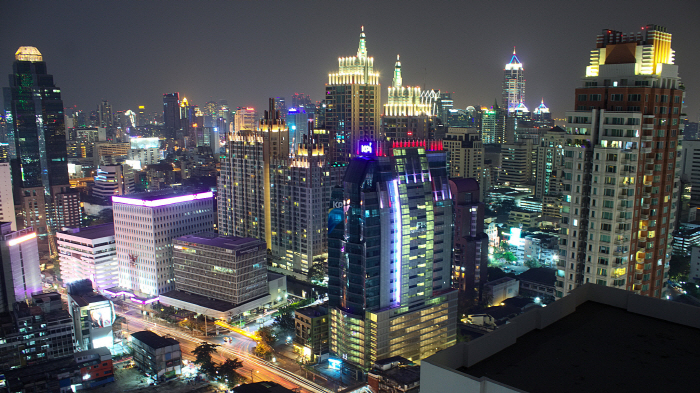
Thaïlande - Bangkok - Night view (Nicloas Vollmer_Flikr)
Wednesday, September 2, 2015 12:36 AM UTC
Editor's Picks



- Market Data
Most Popular




