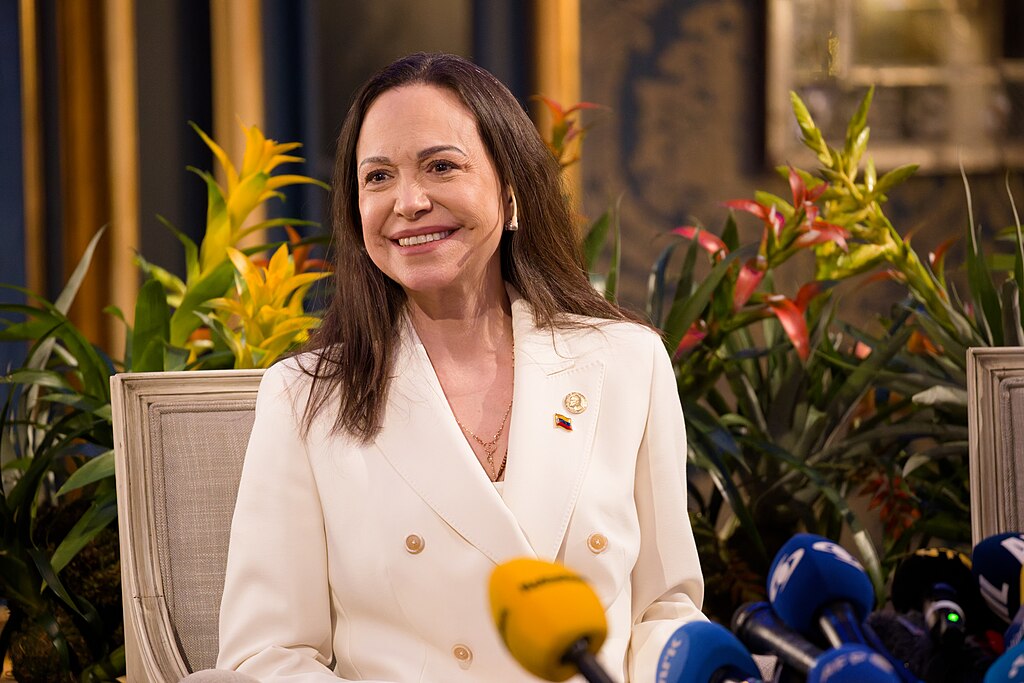
U.S. President Donald Trump said on Tuesday that he is considering involving Venezuelan opposition leader Maria Corina Machado in a future role related to Venezuela, signaling a notable shift in tone toward the South American country and its political opposition. Speaking to reporters at the White House, Trump said his administration has been in discussions with Machado and suggested she could be brought into the process “in some capacity,” though he did not specify what role she might play.
“We’re talking to her and maybe we can get her involved some way,” Trump said. “I’d love to be able to do that.” His remarks followed a recent meeting with Machado, during which she presented Trump with her Nobel Peace Prize, an event that drew international attention and renewed focus on Venezuela’s ongoing political crisis.
Trump’s comments represent a change from his earlier stance on Machado. In the past, he publicly questioned her popularity and political viability, especially after U.S. forces captured Venezuelan President Nicolás Maduro in a high-profile raid earlier this month. Despite those doubts, Machado remains one of the most prominent figures in Venezuela’s opposition movement. Her political party has claimed it won approximately 70% of the vote in the country’s 2024 presidential election, a result that has been widely disputed and criticized by the Maduro government.
The president also struck a surprisingly positive tone regarding Venezuela more broadly. “I felt so strongly against Venezuela, now I’m loving Venezuela,” Trump told reporters, suggesting improved cooperation between Washington and Caracas. He credited this shift to what he described as productive engagement with Venezuela’s interim president, Delcy Rodríguez, adding that recent interactions had been “so nice.”
Trump’s evolving rhetoric on Venezuela, Maria Corina Machado, and U.S.-Venezuela relations could signal a potential recalibration of American policy toward the country. While details remain unclear, the possibility of Machado playing a formal role has sparked speculation about the future of Venezuela’s political transition and the United States’ influence in shaping it.