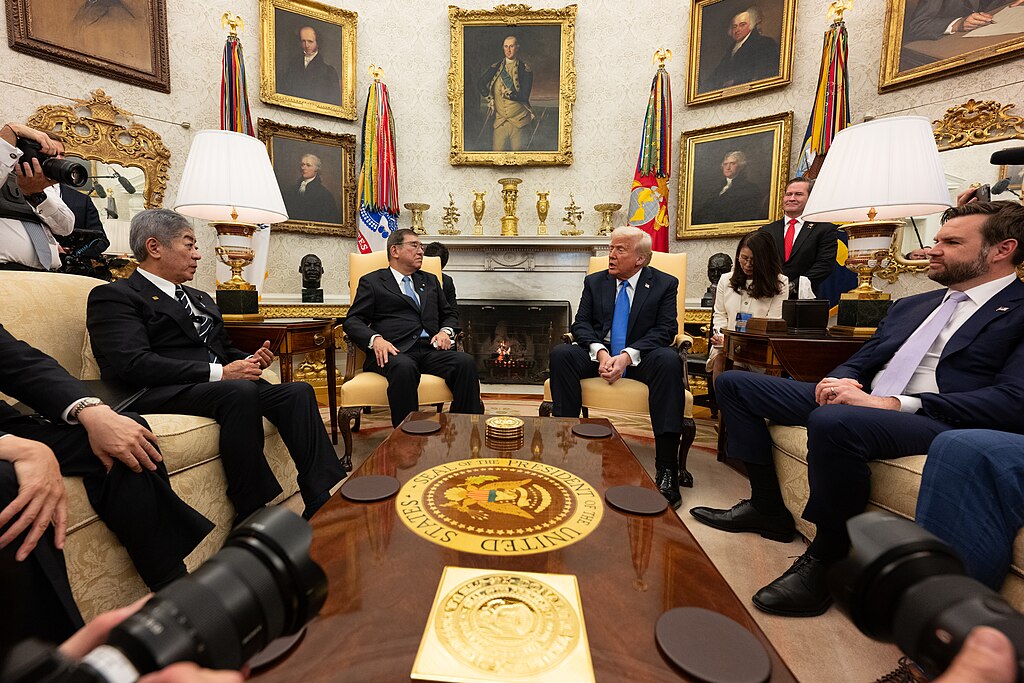
President Donald Trump urged Japan to increase investment in U.S. energy and technology during Prime Minister Shigeru Ishiba’s first White House visit. The leaders discussed Nippon Steel’s $14.9 billion bid for U.S. Steel, which Trump has opposed. Trump noted that Nippon was now considering an investment rather than an outright purchase, causing U.S. Steel shares to drop 6%. However, sources said Nippon had not withdrawn its bid.
The meeting also focused on trade, with Trump pushing Japan to reduce its $68.5 billion trade surplus. Ishiba pledged to increase Japanese investment in the U.S. to $1 trillion and purchase more American liquefied natural gas, ethanol, and ammonia. Japan, which had $783.3 billion in direct U.S. investments in 2023, is also considering a $44 billion gas pipeline in Alaska, though officials remain skeptical.
The two leaders reaffirmed their alliance, addressing concerns over China, North Korea, and Russia. Trump, who has taken a tough stance on trade, imposed a 10% tariff on Chinese imports, heightening global economic tensions. He plans to discuss tariffs with Chinese President Xi Jinping soon.
Despite trade friction, Ishiba emphasized Japan’s commitment to investing in the U.S., highlighting projects by Toyota and Isuzu. He refrained from commenting on potential tariffs. Trump, known for his unpredictable foreign policy moves, expressed confidence in strengthening ties with Japan.
Analysts see Ishiba’s early White House visit as a positive sign for U.S.-Japan relations. Danny Russel of the Asia Society Policy Institute noted that Ishiba handled Trump skillfully, securing goodwill for Japan. However, increased Japanese investment alone is unlikely to eliminate the trade imbalance.