


 Best Gold Stocks to Buy Now: AABB, GOLD, GDX
  Gold Prices Fall Amid Rate Jitters; Copper Steady as China Stimulus Eyed


 Add as a preferred source on Google
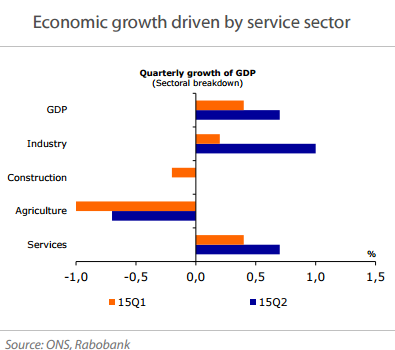
According to the preliminary estimate, UK economic growth picked up to 0.7% q-o-q in the second quarter of 2015, after a slowdown to 0.4% in the first quarter of 2015. However, the recovery seems unbalanced. The services sector, which accounts for more than three quarters of economic output, rose by 0.7% in the quarter, and therefore was the main driver of growth. In contrast, agriculture shrank by -0.7% q-o-q and construction remained flat. And although industrial output increased by 1%, this was mainly driven by an increase in oil output. Manufacturing output, a sub category of industry, fell by 0.3% q-o-q, as British factories struggled due to the strong pound - which weighs on exports.
"We expect the pound to remain strong and thus that a slower export performance could continue to put a drag on manufacturing output and economic growth," says Rabobank.
The latter is in line with data from the CBI Industrial Trends Survey, in which manufacturing orders dropped to a two-year low in July. On the bright side, households' real spending power is improving due to strong nominal wage growth and low inflation.

- News

- Economy

- Central Banks
- Investing
- Research
- Roundups
- Digital Currency
- Insights
- Technical Analysis
- Technology
- Business
- Law
- Health
- Nature
- Fintech
- Science
- Topic
- Opinions
- ©Econometrics LLC . All Rights Reserved.
UK economic growth back on track
Tuesday, August 4, 2015 11:52 PM UTC
Editor's Picks



- Market Data
Most Popular




