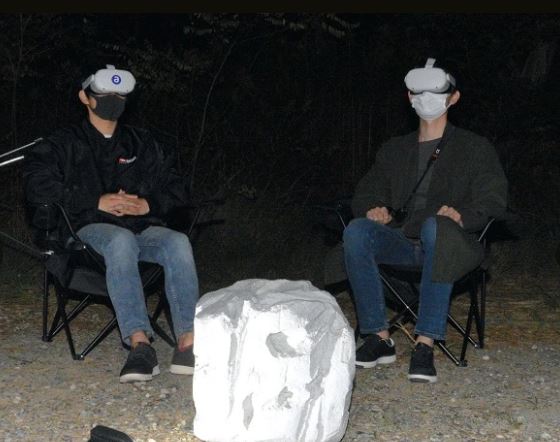
Tokyo-based Amulapo, Inc. is offering a tour at the Tottori Sand Dunes for experiencing a simulated landing on the lunar surface for up to 20 participants on Saturday nights until the end of March, during good weather.
Participants are made to wear virtual reality (VR) goggles upon arrival at the company’s reception area to experience a moon landing, and then don augmented reality (AR) smart glasses when walking to the dunes.
The AR glasses allow participants to experience a lunar development program overlaid on the dunes at night. This involves carrying out five missions, including planting a flag on the surface and scooping up sand.
Yoshiki Takahama, 25, who came from Osaka with three friends, described the experience as extraordinary. He noted that the dunes looked gray while wearing AR smart glasses, and it was cold out there, making him feel that he was standing on the moon.
The Tottori Sand Dunes, located not far from the city center, stretch for about 16 kilometers, making them the largest in Japan.
The tour is available to those at least 18 for $86, including tax.