In last one year Chinese benchmark stock index, Shanghai composite moved up more than 150%, Chinese tech heavy Shenzhen index was up around 200%. From June Shanghai Composite dropped more than 50%.
In last one year Chinese GDP dropped by 0.5 percentage point to 7%, lowest level since crisis. Industrial production growth dropped to 5.6% from 7.9% and now bounced back to 6.8%.
While all seems to be moving, whichever way they might be, one question that arises is what is not moving in China?
The answer is simple, it's Yuan against US dollar.
Amid all of these movement, Peoples bank of China (PBOC) is keeping tight grip over dollar Yuan exchange rate.
While major currencies are in decline, China could use some devaluation of its own which if not done China is likely to face tough competition over global share of exports in the coming years.
How disadvantageous is Yuan?
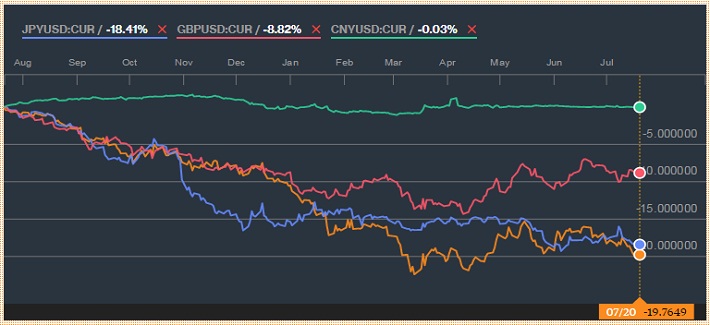
- In last one year Chinese Yuan has depreciated just about 0.03% against dollar, while Pound has depreciated -8.82%, Yen -18.4% and Euro 19.8%.
Moreover such heavily managed Yuan is unlikely to gain a seat in IMF's SDR. In order to make China and Yuan global, PBOC should remove its invisible hand.