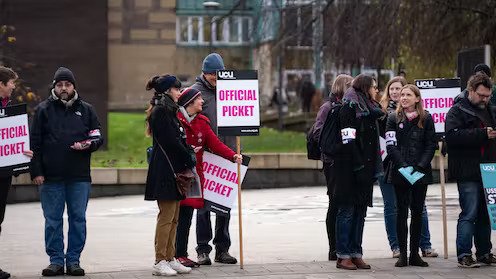
Universities in the UK are striking on 24, 25 and 30 November 2022, with action short of a strike beginning on 23 November. Around 70,000 university staff across 150 universities are taking industrial action, following a series of smaller strikes in recent years. These strikes may be the largest ever in the higher education sector, after members of the University and College Union backed a national ballot in favour of industrial action.
The UCU is now the only union in the education sector to secure a national mandate for strike action since the 2016 Trade Union Act restricted unions’ ability to call a strike. The entire higher education sector could be brought to a standstill.
When staff in higher education went on strike in 2019, the dispute was mainly around pensions. There was also growing unrest in the sector around pay and working conditions. At the time, I argued that this unrest intensified following the introduction of higher student fees in 2010.
Since 2019, issues around pay and working conditions have now surpassed pensions and become the main driver for the strikes.
The UCU’s demands include a pay rise in recognition of the cost of living crisis, after a 3% increase in 2022, and an end to insecure contracts. On pensions, UCU wants employers to reverse the cuts imposed in 2022, which it claims will see the average member lose about 35% from their future retirement income.
The detailed demands in the pay and working conditions dispute also include action to close gender, ethnic and disability pay gaps, action on excessive workloads and unpaid work, and a standard weekly full-time contract of 35 hours.
The road to the strikes
A wide range of factors within higher education in the UK, as well as in the union, have contributed to the decision to take industrial action. Beyond the ongoing pensions dispute, university staff have faced the effects of the increased marketisation of education, including a rise in precarious, short-term working contracts.
In parallel, the UCU has gained a more politicised and confrontational union leadership, as well as making a push towards workplace organising combined with a strong social media campaign and presence.
In a press conference giving the results of the ballots, UCU general secretary, Jo Grady, confirmed the union’s confrontational approach with three messages. The first was to employers: “The game has changed … now we will take you on as a collective.” Second was a message to politicians, that the sector should not be a “punch bag for cuts, right-wing attacks and political point scoring”. The third went to representatives and members: “I am UCU and proud, and I really hope you are too.”
The chief executive of the Universities and Colleges Employers Association (UCEA), Raj Jethwa, said there was “disappointment” across the sector at the decision to strike, taken despite discussions on bringing forward the 2023-24 pay negotiations in response to cost of living concerns.
A successful strike depends on whether arguments to take collective action resonate with workers – and the wider public. These arguments need to be circulated both internally within trade unions and externally to society as a whole. Internally, the union needs to create a collective identity. Externally, it needs to communicate effectively with journalists, politicians and the wider public.
Not all workers have decided to join the strike, and this might be because arguments do not resonate: they may not be subject to the same pay and working conditions issues as the majority of the sector. It is also worth saying that workers may not be participating because of pressure by their employers or for financial reasons. Taking strike action is a “last resort” for most workers and these decisions are not taken lightly.
Trade unions have been criticised for being slow to fully exploit newer technologies like social media. The use of social media – combined with relentless campaigning and local meetings – has been a key mobilising tactic in the UCU dispute. This approach has the potential to revitalise the political influence of trade unions.
The UCU has also tried to bring the needs of students into the frame, particularly by using the phrase “students know our working conditions are their learning conditions”.
Gaining public support for a strike, though, requires winning the moral argument – especially problematic in a time of economic crisis where workers more generally are suffering from low pay and poor working conditions. This is difficult in higher education. The working conditions and workload of academics lack visibility: people wonder “what academics actually do”. The UCU will need to effectively explain the squeeze academics are facing, from increased teaching loads and pressure to meet student expectations to the need to secure funding and publish research.