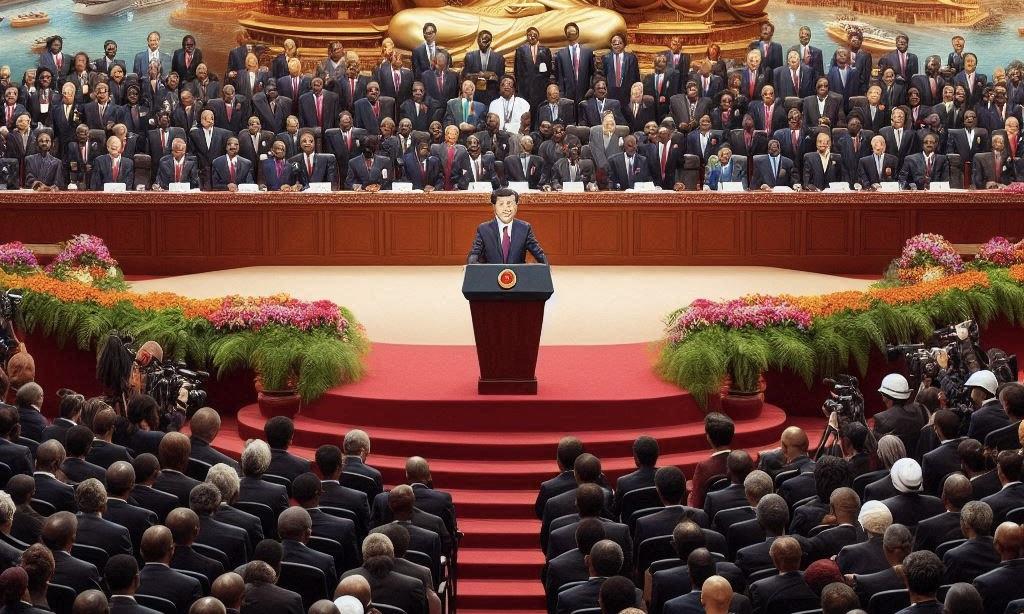
During Beijing’s largest summit since the pandemic, Chinese President Xi Jinping pledged over $50 billion in financing for Africa, alongside promises to create one million jobs. His address highlighted China’s commitment to deepening cooperation in infrastructure, agriculture, and trade with African nations.
Over 50 African Leaders Join Xi Jinping in Strengthening Ties with $50 Billion in Financing and Job Creation Promises
In his address to Beijing's largest summit since the pandemic, Chinese leader Xi Jinping pledged more than $50 billion in financing for Africa over the next three years. He also expressed his intention to enhance cooperation in infrastructure and trade with the continent.
According to state media, over 50 African leaders and UN Secretary-General Antonio Guterres will attend the China Africa forum this week.
African leaders have already concluded numerous agreements this week to enhance collaboration in the areas of infrastructure, agriculture, mining, commerce, and energy.
Xi praised the "best period in history" of the ties between the continent and the leaders at the forum's inauguration ceremony on September 5 in Beijing's ornate Great Hall of the People.
“China is ready to deepen cooperation with African countries in industry, agriculture, infrastructure, trade and investment,” he said.
“Over the next three years, the Chinese government is willing to provide financial support amounting to 360 billion yuan ($50.7 billion),” Xi said.
He stated that more than half of the amount will be in credit, with $11 billion in "various types of assistance"and $10 billion in incentives for Chinese firms to invest.
He also promised to help “create at least one million jobs for Africa.”
China Deepens Ties with Africa Through Resource Investments and Infrastructure Deals Amid Geopolitical Shifts
In a recent report by Fortune, Africa's largest trading partner is China, the world's second-largest economy. China exploits the continent's abundant natural resources, such as copper, gold, lithium, and rare earth minerals.
It has also provided African countries with billions in loans, facilitating the construction of much-needed infrastructure. However, it has occasionally stoked controversy by burdening governments with substantial obligations.
According to analysts, Beijing's generosity toward Africa is being reevaluated in light of domestic economic challenges, and geopolitical concerns regarding a developing conflict with the United States may be increasingly influencing policy.
However, bilateral meetings conducted concurrently with the summit resulted in numerous commitments to enhance collaboration on various projects, including solar panels, avocados, and railways.
On September 4, Zambian President Hakainde Hichilema announced that he had supervised a partnership between the state-owned power company ZESCO and Beijing's PowerChina to increase the utilization of rooftop solar panels in Zambia.
Nigeria and China signed a joint statement, agreeing to "intensify cooperation" in infrastructure, including "transportation, ports, and free trade zones." Nigeria is one of Beijing's largest debtors on the continent.
Tanzania, Zimbabwe, and Kenya Secure Major Infrastructure and Trade Deals with China at Beijing Summit
Samia Suluhu Hassan, the President of Tanzania, subsequently secured a pledge from Xi to advance the long-stalled railway that connects his country to Zambia.
Zambian media have reported that Beijing has committed $1 billion to the initiative, which is designed to enhance transportation connections in the continent's resource-rich eastern region.
According to a joint statement by the two nations, Zimbabwe also secured commitments from Beijing to enhance cooperation in "agriculture, mining, environmentally friendly traditional and new energy, and transportation infrastructure."
The joint statement also stated that the southern African nation and Beijing had agreed to sign a contract permitting the export of fresh Zimbabwean avocados to China.
Kenyan leader William Ruto stated that Xi had pledged to expand China's agricultural markets to include products from his country.
The Standard Gauge Railway, which connects Nairobi, the capital, to the coastal city of Mombasa, was constructed with financing from the Exim Bank of China. The two parties have mutually consented to collaborate on its expansion.
Additionally, according to Kenyan media, Ruto obtained a commitment to enhance collaboration with China on the Rironi-Mau Summit-Malaba motorway, which is anticipated to cost $1.2 billion.
Last year, Ruto requested a $1 billion loan from China and the restructuring of existing debt to finalize other stalled construction projects. The country is currently in debt of more than $8 billion.