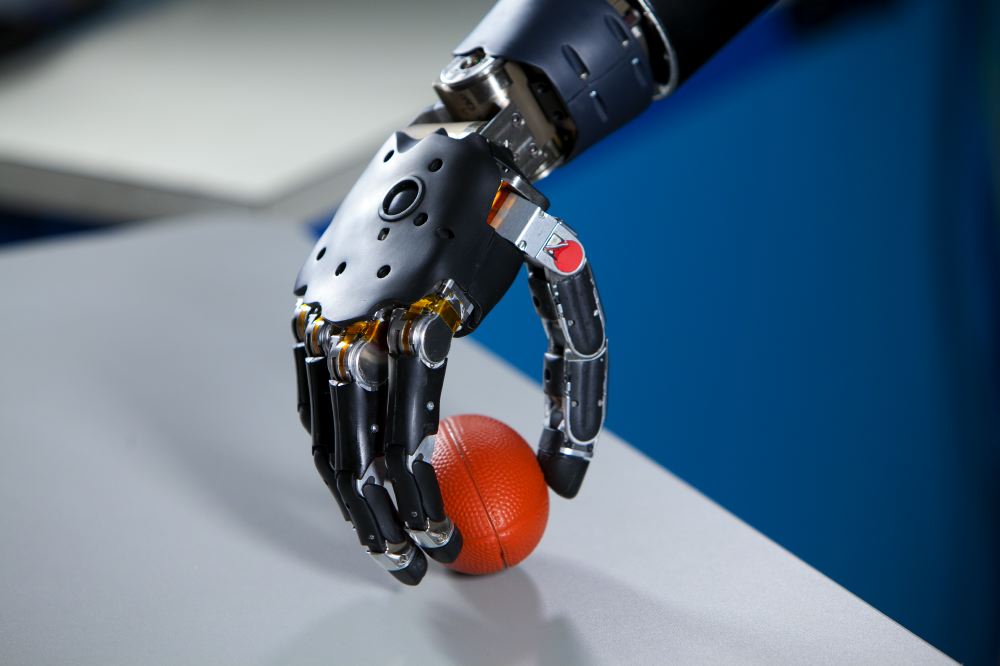
Prosthetics seems to be advancing at an exponential level. A man from Florida who lost his arm to cancer was just given a robotic arm that can be controlled with his mind and costs $120 million to make. The arm will be with him for a year, which should provide a significant amount of data to help develop the technology even further.
The arm was developed by researchers at the Johns Hopkins Applied Physics Lab under the program called Revolutionizing Prosthetics, Quartz reports. The recipient of the prototype called the Modular Prosthetic Limb (MPL) is Johnny Matheny of Port Richey, Florida who will be wearing the robot arm over the next 12 months.
Funding for the project came from the Defense Advanced Research Projects Agency (DARPA). The goal of the project is to develop a robot limb that can be controlled by the brain in much the same way as real arms are and with similar levels of natural feeling.
The researchers basically want to eventually create an arm that functions just as well or even better than a real arm, and with practically the same level of effort from the person wearing the prosthesis. This is also in line with what futurists and tech moguls like Tesla CEO Elon Musk are aiming for.
Notorious for his caution towards artificial intelligence, Musk has been a huge driving force in creating technology that would enhance human capabilities. By creating bionic options to make people stronger, smarter, faster, and generally more capable, the threat of AIs and robot overlords won’t be as great.
For now, the public will need to content itself with the MPL, which still has a lot of restrictions. The arm can’t get wet and Matheny isn’t allowed to drive while using it, Futurism reports. Other than those and a few other rules, however, the researchers are giving Matheny free reign to test the limits of the arm.