


 BOJ Raises Interest Rate to 31-Year High as Yen Weakens
  Mike Rogers Calls for End to US-Canada Tariff War
  ECB May Stop Rate Hikes After December, Capital Economics Says
  U.S. Government Moves Over $100M in Bitcoin and BNB
  US Stock Futures Flat as Fed Minutes, Earnings Loom
  Bitmine to Stop Ethereum Buying After Reaching 5% ETH Supply
  BofA Raises Coinbase Stock Target to $203 on Stablecoin Growth
  Fed Minutes Signal Another Rate Hike by Year-End
  UK House Prices Flat in September as Mortgage Rates Weigh
  US Dollar Hits 18-Month High as Fed Signals More Rate Hikes
  Fairshake Backs 32 Pro-Crypto House Candidates
  Zcash Mining Profits Surge as Liquidity Risks Grow
  BlackRock’s Rick Rieder Favors Bonds Over Stocks as Treasury Yields Surge
  Fed’s Hammack Says More Data Needed Before Next Rate Move
  Kazakhstan and Tether Explore Tenge Stablecoin and RWA Tokenization
  Dollar Retreats From 18-Month High as Euro Rebounds


 Add as a preferred source on Google
Australia's Q1 GDP report released on Wednesday came in largely in line with market forecasts but weaker than the implied quarterly forecast published in the RBA’s May Statement on Monetary Policy. Australia's GDP rose by a modest 0.3 percent q/q in Q1, compared to 0.2 percent estimated in Reuters poll. The annual growth was down to 1.7 percent from 2.4 percent in Q4. This is the lowest rate of growth since 2009.
The slightly better than expected data came one day after the Reserve Bank of Australia (RBA) cautioned that growth "is expected to have slowed in the March quarter." The central bank held rates unchanged at 1.50 percent and said it remains upbeat on the global outlook, domestic business conditions, and non-mining investment outside the regions impacted by the mining downturn.
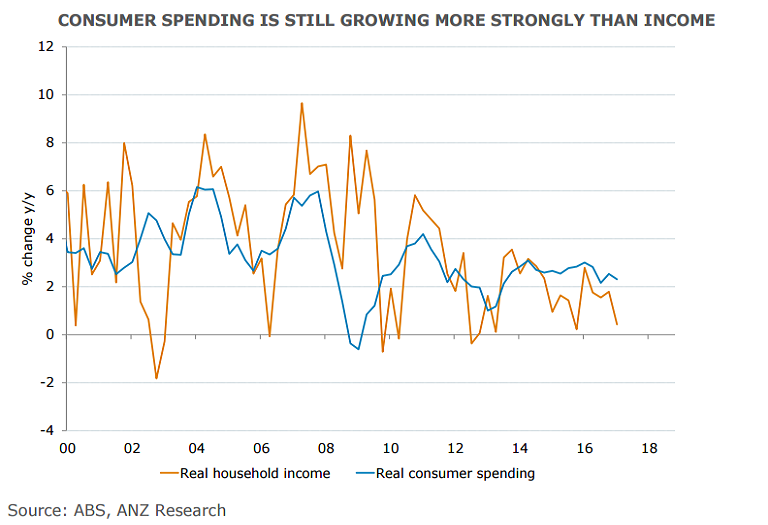
Australia's economy just managed to squeeze out enough growth to stay out of a recession for the 26th year running. That said, as households struggle with paltry wage rises and punishing debt, its sustenance is in doubt. Unit labour costs rose 0.6 percent q/q, but are only 0.1 percent higher than a year ago suggesting an absence of domestic inflationary pressures and confirming that the RBA is on hold for some time.
The inflation indicators extended weakness. The household consumption deflator rose just 0.3 percent q/q, while the core rate was up just 0.2 percent and is only 0.8 percent higher over the year. The weak GDP data for Q1 will not unsettle the Reserve Bank of Australia (RBA) as it had expected a weak result.
"There looks to have been a sustained step-down in the pace of consumer spending growth as households adjust to the new world order of very low wage growth. On that front, wages growth actually picked up in the quarter, but growth in unit labour costs remains negligible, which suggests that inflation is likely to stay low. On this whole, this confirms our view that the RBA is on hold for some time," said ANZ Markets in a research note.
Aussie buoyed after Australia Q1 GDP beats estimates. AUD/USD rose to 0.7566, the highest level since April 25, and is currently hovering at session highs. The pair has broken 200-DMA at 0.7531 and close above will see further upside.
FxWirePro's Hourly AUD Spot Index was at 96.6914 (Bullish), while Hourly USD Spot Index was at 33.229 (Neutral) at 1145 GMT. For more details on FxWirePro's Currency Strength Index, visit http://www.fxwirepro.com/currencyindex.







