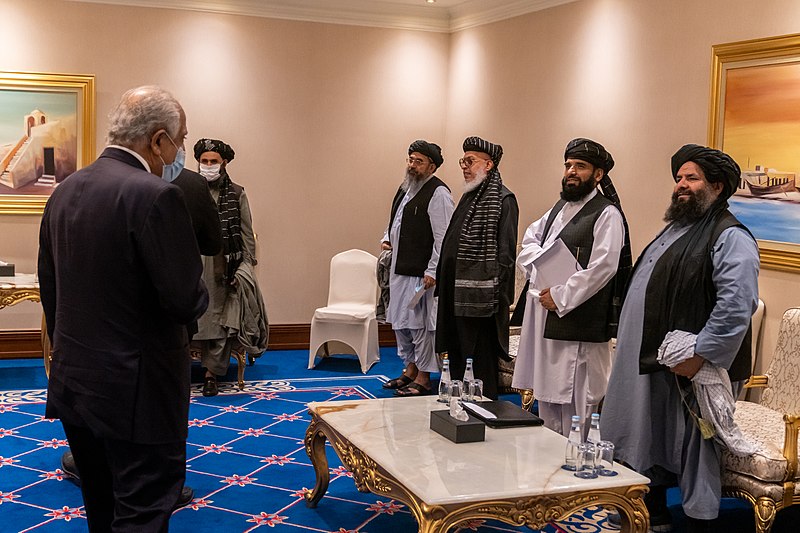
As the Taliban seeks to obtain international recognition, it is facing criticism for its policies on women and girls, which remain restrictive. The US special envoy for Afghanistan met with the insurgent group’s foreign minister in Doha for talks, stressing the importance of upholding women’s rights.
Over the weekend, the US special envoy for Afghanistan, Thomas West, traveled to Doha, Qatar, to meet with the Taliban foreign minister Amir Khan Muttaqi. West stressed the opposition of the international community to the Taliban’s restrictive policies on women and girls upon regaining control of the country in August last year.
“Girls must be back to school, women free to move & work w/o restrictions for progress to normalized relations,” said West on Twitter, following his meeting with Muttaqi.
The policies of the Taliban on women and girls today harken to its first hardline rule back in the 1990s. Schools for girls have yet to reopen, and while the group has maintained that it wants girls back to school, they said the delay is due to a variety of reasons, from infrastructure to the lack of resources because of the country’s economic crisis.
The Taliban previously pledged to uphold the rights of women and girls when they took power in August, but the group’s actions have raised concerns.
This also follows the decree by the Taliban’s Supreme Leader that women should be fully covered in public, including their faces, preferably with the traditional burqa. More restrictions have been implemented since then despite increasing criticism.
The Taliban leaders announced Thursday last week that female anchors in Afghanistan must also cover their faces while on air. Not many news outlets complied with the order at the time, but most female anchors complied by Sunday when the group enforced the decree.
The Information and Culture Ministry announced that the decree was “final” and “non-negotiable.”
Afghanistan’s TOLONews anchor Sonia Niazi told Al Jazeera that the decree is “unpredictable,” noting that “Islam does not command us to cover our faces.” Niazi also said that Islamic scholars and political figures have opposed the decree.
In an act of solidarity, the channel’s male personnel also donned masks.