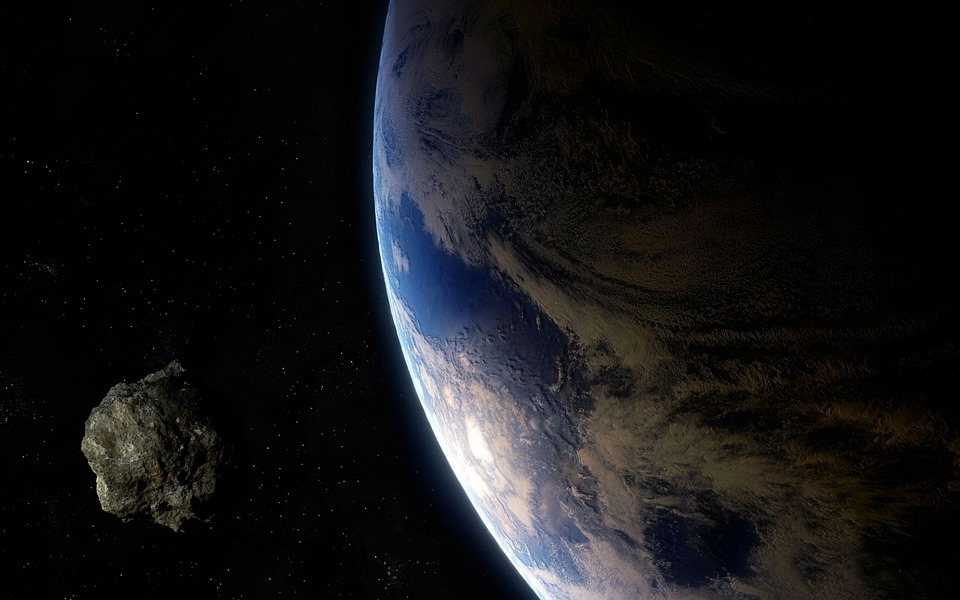
Space objects like asteroids regularly pass by our own planet, with some more massive than others. NASA has confirmed that an asteroid will be making its approach to Earth in time for Christmas on the day itself.
It appears that even space is joining in on the festivities as an asteroid that is referred to as 2014 SD224 is making its way Earthbound this month. SD224 will be making its way to Earth just in time for Christmas on the day itself, December 25. 2014 SD224 is a relatively massive asteroid measuring around 123 meters in diameter. By the time it approaches our planet, the space rock would be traveling at a speed of 10 kilometers per second or 36,000 kilometers per hour.
Fortunately, even with its size, SD224 does not pose a threat to our planet. It will only get as close as 3,076,775 million kilometers away, around eight times the distance between Earth and the Moon. Even with its size, NASA has classified the asteroid as a Near-Earth Object.
At the same time, Japan’s space agency JAXA was able to successfully complete its mission of obtaining soil samples from asteroid Ryugu this week. The Hayabusa2 spacecraft’s capsule that contained the samples from the space rock was safely retrieved when it made a landing in Australia. The spacecraft released the capsule on Saturday, and upon reaching 10 kilometers away from Earth, the capsule opened up a parachute to slow down its descent while beacon signals were triggered in order for scientists to determine its location when it makes its landing in the Woomera wilderness.
The search team of JAXA was able to retrieve the 40-centimeter capsule after two hours since its re-entry to Earth. The agency’s Hayabusa2 spacecraft left asteroid Ryugu last year. Upon releasing the capsule of Ryugu samples, the spacecraft will make another journey to another distant asteroid. Following JAXA’s confirmation of being able to successfully retrieve the capsule, they were congratulated by officials at NASA, such as the agency’s associate administrator of Science Mission Directorate Dr. Thomas Zurbuchen.
“Together, we’ll gain a better understanding of the origins of our solar system & the source of water & organic molecules that may have seeded life on Earth,” tweeted Dr. Zurbuchen.