
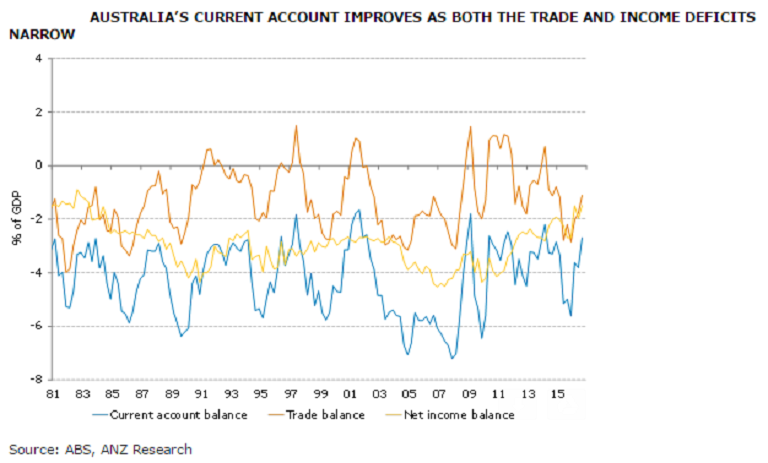
Australia’s current account deficit narrowed sharply in Q3, underpinned by a strong pickup in export prices and an improvement in the net income deficit. Net exports subtracted 0.2ppts from GDP growth. With commodity prices increasing the trade deficit is forecast to narrow further in Q4.
Australia’s current account deficit (CAD) narrowed to 2.7 percent of GDP from an upwardly revised 3.8 percent in Q2 2016. The improvement was driven by a narrowing of the trade deficit to AUD4.7 billion from AUD7.4 billion in Q2 2016 as well as an improvement in the net income deficit (from 2 percent of GDP in Q2 to 1.5 percent in Q3).
The volume of exports ticked 0.3 percent higher in Q3, underpinned by a strong rise in services exports volumes (+2.4 percent q/q), while manufacturing and resource exports both declined. The weakness in resource exports (-0.1 percent q/q) was driven by iron ore, while other mineral fuels and metals were also down. Coal (+2.6 percent) and non-monetary gold (+7.4 percent) exports rose. Rural exports volumes were also higher.
In addition, export prices rose by 3.4 percent q/q in Q3, the largest quarterly increase since mid-2013, driven by the recent rally in commodity prices. As a result, the value of exports rose by 3.7 percent q/q – which is the highest quarterly increase since September last year.
Import volumes rose 1.3 percent q/q in Q3, with strength in capital and intermediate goods imports. Consumption goods imports fell sharply (down 3.3 percent q/q in Q3) and more than reversed the increase over the previous quarter. The weak reading for consumption goods imports is to some extent consistent with the softer tone for retail sales volumes in Q3.
"Overall, the terms of trade rose 4.4 percent in Q3 after a 2.3 percent increase in the previous quarter. We expect the term of trade to continue to strengthen in Q4 supported by the rally in commodity prices," ANZ Research commented in its recent report.
Meanwhile, the AUD/USD is trading bearish at 0.74, down 0.32 percent, while at 6:00GMT, the FxWirePro's Hourly AUD Strength Index remained neutral at -47.77 (a reading above +75 indicates a bullish trend, while that below -75 a bearish trend). For more details, visit http://www.fxwirepro.com/currencyindex

