
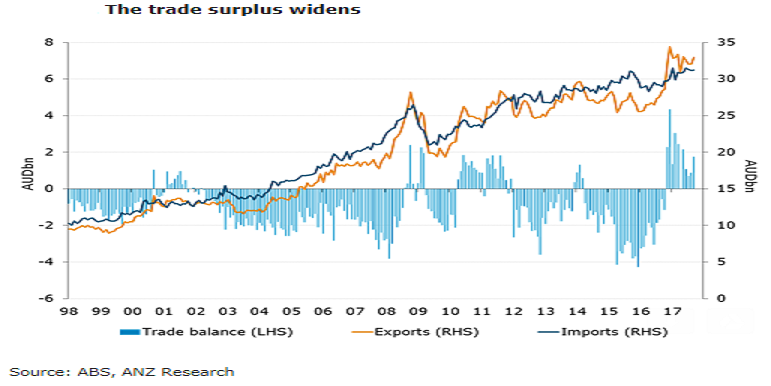
Australia’s net exports are expected to add 0.3ppts to third quarter real GDP growth, according to the latest report from ANZ Research. The country’s trade surplus widened in September to AUD1,745 million from a downwardly revised AUD873 million the previous month.
The improvement in the trade position was led by a rise in export values – up 2.9 percent in September. Metal ores and minerals (+8 percent m/m) and services (+1.4 percent m/m) were the main contributors to the acceleration in export growth.
Resources ex-nonmonetary gold saw the fastest increase in the month (+3.8 percent m/m). The strength in metal ores and mineral (+8 percent m/m) offset declines in coal (-0.3 percent m/m) and other mineral fuels (-1.2 percent m/m). Encouragingly, service exports (up AUD102 million) continued to strengthen, growing 1.4 percent m/m.
Import values were steady for the second straight month in September. Imports of intermediate goods and services both fell in the month, down 0.4 percent (AUD35 million) and 1.3 percent m/m (AUD97 million), respectively. Imports of consumption goods grew, after declining in the prior two months, increasing AUD191 million (+2.4 percent m/m).
However, capital goods imports improved (+0.9 percent m/m), likely reflecting the strong pipeline of infrastructure projects. Service imports were a drag as they fell AUD97 million (-1.3 percent m/m).
Meanwhile, FxWirePro launches Absolute Return Managed Program. For more details, visit http://www.fxwirepro.com/invest

