


 Trump Calls for Zelenskyy Replacement Amid Russian Diesel Deal
  US, EU Push for Action Against Asia’s Excess Factory Capacity
  Best Gold Stocks to Buy Now: AABB, GOLD, GDX
  Gold Prices Rise as Dollar Weakens, Treasury Yields Fall
  Asian Currencies Steady as Dollar Eyes Fourth Weekly Gain
  Dollar Near 18-Month High as Euro, Yen and Pound Weaken
  Iran Refuses to Halt Uranium Enrichment Amid US Nuclear Demands
  US-Led Coalition Targets Global Factory Overcapacity
  Oil Prices Rise as Gulf Hurricane and Middle East Supply Risks Mount


 Add as a preferred source on Google
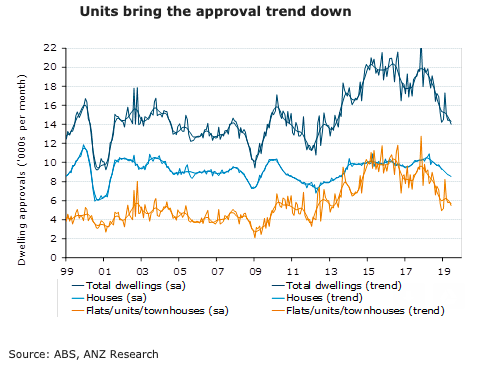
Australia’s building approvals were down 9.7 percent over July, driven by an 18.4 percent fall in units and a smaller 3.3 percent fall in houses, marking the third lowest annual result in both the last year and the last decade.
Further, a sharp reduction in unit approvals, led by Sydney and Melbourne, may be a sign that quality concerns are having an impact on apartment supply, according to the latest report from ANZ Research.
Private sector house approvals were down 3.3 percent m/m, wiping out modest gains in June and are now down 16.6 percent y/y. House approvals have fallen an average of 1.5 percent per month for the last year, with only three months where growth was positive.
Victoria and New South Wales had very weak monthly approvals results ( −17.5 percent and −24.3 percent m/m respectively), driven by falls in unit approvals of more than 40% in each state.
Meanwhile, Queensland, South Australia and Western Australia saw bumps in approvals through July, concentrated in unit growth. In annual seasonally adjusted terms, major states saw approvals fall (−36.9 percent y/y NSW, −25.8 percent Victoria, −22.3 percent Qld) driven by units, while South Australia saw a substantial rise (28.9 percent y/y).
The renewed decline in unit approvals in the last couple of months, concentrated in the “investor states” of New South Wales and Victoria, may reflect quality concerns in some large apartment developments.
The value of non-residential approvals weakened in July (-9.9 percent m/m), wiping out most of the gain in June (10.5 percent m/m). This is likely to reflect short-term volatility in approvals. Trend growth in non-residential approvals is filling some of the gap left by the weaker housing sector, the report added.
"Credit easing following APRA changes in July and rate cuts in June and July may flow through to approvals eventually, although the renewed downward trend in unit approvals after a short-lived stabilisation poses a risk to our outlook," ANZ Research further commented in the report.







