


 Gold Prices Hit One-Week High as Oil Falls, Fed Rate Outlook Weighed
  Dollar Near 18-Month High as Euro, Yen and Pound Weaken
  Gold Prices Fall as Fed Signals Another Rate Hike
  European Stocks Fall as Oil Rises Ahead of Fed Minutes
  RBI Raises Repo Rate to 5.50% in Hawkish Shift on Inflation Risks
  France to Release 10 Million Barrels of Diesel to Ease Fuel Prices
  Bangladesh GDP Growth Accelerates to 4.6% on Industrial Rebound
  Oil Prices Rise as Gulf Hurricane and Middle East Supply Risks Mount
  Gold Prices Rise as Dollar Weakens, Treasury Yields Fall
  Oil Prices Slip as Trump Rules Out Iran Strike Before Midterms
  US, EU Push for Action Against Asia’s Excess Factory Capacity


 Add as a preferred source on Google
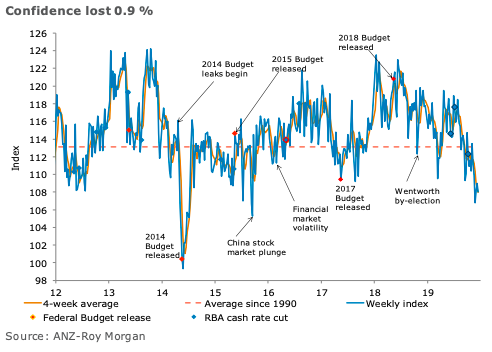
Australia’s ANZ-Roy Morgan consumer confidence fell 0.9 percent last week, primarily due to the 6.4 percent fall seen in the ‘Time to buy a major household item’ sub-index.
Financial conditions were mixed with ‘current finances’ down by 1.5 percent, while ‘future financial conditions’ gained 3.7 percent. Economic conditions were also mixed.
‘Current economic conditions’ rose 1.6 percent, while ‘future economic conditions’ were down 1.2 percent. The four-week moving average of ‘inflation expectations’ was up 0.1ppt to 4.0 percent.
"Momentum fizzled out this week after two successive weekly gains. A delayed response to the soft GDP result and weak retail sales may be at work, as well as the news flow around the bush fires and associated smoke haze. The weakness seen in the ‘time to buy a household item’ sub-index was almost enough to take it to its lowest level since the global financial crisis. It seems the turn in the housing market has not yet flowed through to sentiment around household items. We note that consumer confidence is not the be all for financial conditions. The financial wellbeing of Australians is holding up better," said David Plank, ANZ’s Head of Australian Economics.







