


 Oil Prices Rise as Gulf Hurricane and Middle East Supply Risks Mount
  Crypto Market Selloff Wipes Out $100B as Bitcoin Falls Below $83K
  Gold Prices Fall as Fed Signals Another Rate Hike
  Dollar Near 18-Month High as Euro, Yen and Pound Weaken
  Asian Stocks Mixed as OpenAI Revenue Concerns Hit Chipmakers
  Gold Prices Rise as Hormuz Tensions Fuel Inflation Risks
  US-Led Coalition Targets Global Factory Overcapacity
  Gold Prices Hit One-Week High as Oil Falls, Fed Rate Outlook Weighed


 Add as a preferred source on Google
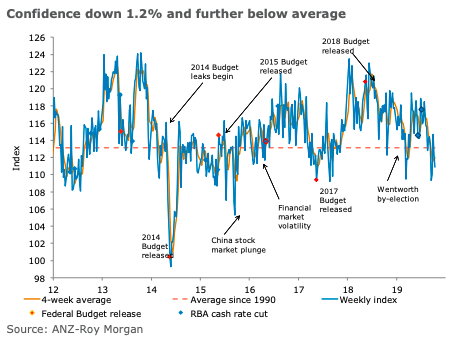
Australia’s ANZ Roy Morgan consumer confidence index was down 1.2 percent last week, its second straight weekly loss – ensuring confidence remains below its long-run average.
The financial conditions sub-indices were positive. Current finances gained 0.2 percent, while future finances were up 0.7 percent. These small gains coming after large falls last week.
In contrast weakness in the economic conditions sub-indices continued for a second week. Current economic conditions fell 1 percent, while future economic conditions lost 1.7 percent.
The ‘Time to buy a household item’ measure fell 3.9 percent after two successive gains. Inflation expectations (IE) remained stable at 4.1 percent.
"Consumer confidence was down 1.2 percent last week, despite some positive developments in the US-China trade war. The decline leaves overall sentiment below average. Household perceptions of the economic outlook fell for a second consecutive week and are well below average. It will be interesting to see whether economic sentiment can gain this week as households have more time to consider the news on trade. In contrast to the negative economic outlook, households remain much more confident about their own financial outlook. This week’s employment data could be important in this regard. Stable inflation expectations, albeit at a low level by historical standards, will be comforting for the RBA," said David Plank, ANZ’s Head of Australian Economics.







