
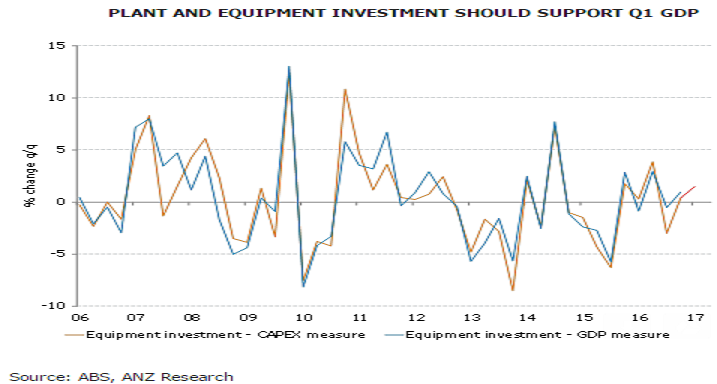
Australia’s CAPEX for the first quarter of this year is expected to post a mild increase of 1.2 percent q/q, an encouraging result after four consecutive quarterly declines. Buildings and structures investment is likely to rise slightly, in line with last week’s data showing that business construction had nudged higher.
The most important part of the Q1 result is the investment in plant and equipment (P&E), which flows directly into GDP and it is expected to rise 1.5 percent q/q, given solid capital goods imports in the quarter. This is likely to be one of the few positive notes in next week’s GDP report, where the Q1 growth of is seen at just 0.1 percent q/q, ANZ Research reported.
Encouragingly, non-mining investment in 2017-18 is expected to be revised higher to AUD58 billion, implying a 5.7 percent y/y rise, compared to the anticipated 3.7 percent y/y rise reported last quarter. This stronger outlook comes in line with an improved business environment, with reported trading conditions, confidence and profitability all sitting around the highest levels since the global financial crisis.
"Looking ahead, we anticipate that firms will revise higher their estimate for CAPEX in 2017-18. ANZ’s raw estimate forecast of AUD88 billion would imply (after allowing for firms’ historical misses at this early stage) a 3.6 percent y/y fall in total CAPEX, although this is still significantly hindered by the mining sector," the report added.

