


 Oil Prices Rise as Houthi Attacks Threaten Middle East Supply
  Bangladesh GDP Growth Accelerates to 4.6% on Industrial Rebound
  France to Release 10 Million Barrels of Diesel to Ease Fuel Prices
  US Treasury Yields Ease After Strong 10-Year Auction as Global Bonds Struggle
  Mike Rogers Calls for End to US-Canada Tariff War
  US, EU Push for Action Against Asia’s Excess Factory Capacity
  Iran Refuses to Halt Uranium Enrichment Amid US Nuclear Demands
  Oil Prices Rise as Hormuz Risks Offset IEA Stock Release
  Best Gold Stocks to Buy Now: AABB, GOLD, GDX
  Wall Street Falls as Oil Prices Rise and Tech Stocks Slide
  Gold Prices Rise as Dollar Weakens, Treasury Yields Fall


 Add as a preferred source on Google
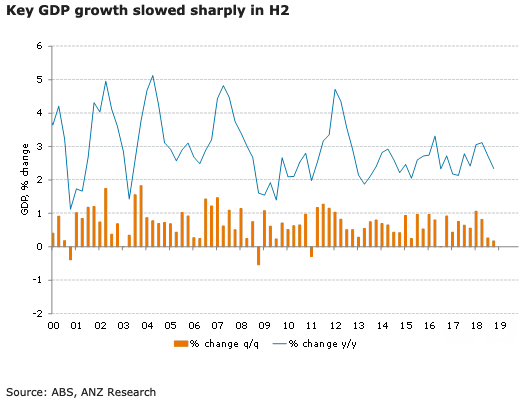
Australia’s gross domestic product (GDP) for the last quarter of 2018 slowed to 0.2 percent q/q and 2.3 percent y/y. Looking at Q3 and Q4 together shows that annualised growth in the second half was 0.9 percent, a sharp step down from 3.8 percent in H1, with a notable softening in the household sector.
Also, the result is significantly weaker than the RBA’s forecast of 2.8 percent y/y published in the February Statement on Monetary Policy, ANZ Research reported.
Q4 growth was also held down by weak exports, farm output and mining investment, while public spending and non-mining business investment were the bright spots. Housing construction fell 3.4 percent q/q, while household consumption was up just 0.4 percent q/q.
In contrast, the business, public and export sectors look solid. Non-mining investment rose a strong 2.4 percent q/q and expectations remain for further solid growth.
Public spending rose 1.5 percent q/q and is likely to continue to contribute to growth given a large pipeline of state-backed infrastructure spending and the rollout of the National Disability Insurance Scheme.
"The key uncertainty continues to be around the outlook for consumer spending in an environment of persistently low wages growth, and falling house prices. While household income is slowly picking up, households look to be realising that income growth will not rise to the pace that we saw last decade, and spending will need to grow more in line with income," ANZ Research commented in its latest report.







