


 US Stock Futures Flat as Fed Minutes, Earnings Loom
  Wall Street Falls as Oil Prices Rise and Tech Stocks Slide
  Oil Prices Trim Gains After Trump Rules Out Iran Strikes Before Midterms
  Fed Minutes Signal Another Rate Hike by Year-End
  France to Release 10 Million Barrels of Diesel to Ease Fuel Prices
  Deere, CNH and AGCO Stocks Fall as FTC Launches Farm Equipment Probe
  European Stocks Fall as Oil Rises Ahead of Fed Minutes


 Add as a preferred source on Google
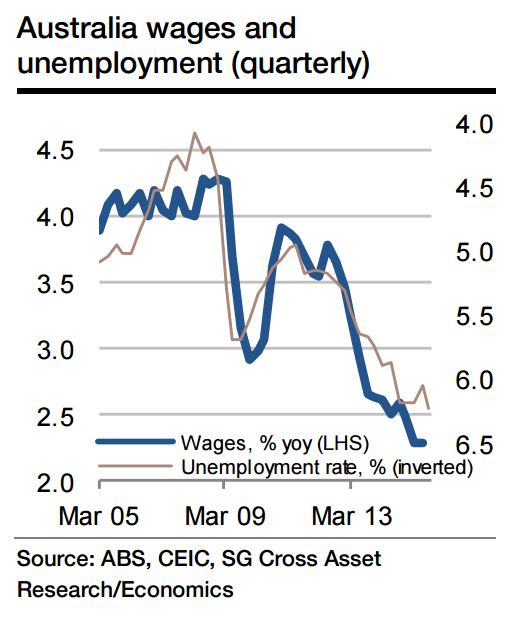
As unemployment in Australia started to rise in late 2012, wage growth slowed. By the start of this year, annual wage growth (excluding bonuses) had declined to 2.3%, the lowest in the series' - admittedly fairly short - history (it started in mid-1997). With unemployment now at least having peaked, and households' improved perceptions about the state of the labour market, wage growth is expected to also bottom out and start to recover into 2016.
For an outright recovery Q3 is probably still too early. Two things should, however, be noted. One, although nominal wage growth is running at the lowest rate since the series' inception, inflation adjusted wage growth at 0.8% yoy is fractionally above the historical average of 0.7%.
Two, wage growth including bonus payments is running at a slightly higher rate of 2.6% yoy, 0.3pp higher than the ex-bonus figure that for some reason grabs most of the headlines. So, the misery inflicted on Australia's wage earners is arguably less pronounced than this series suggests, and combined with employment growth of just above 2% yoy, real wages and salaries are growing at a solid rate.

- News

- Economy

- Central Banks
- Investing
- Research
- Roundups
- Digital Currency
- Insights
- Technical Analysis
- Technology
- Business
- Law
- Health
- Nature
- Fintech
- Science
- Topic
- Opinions
- ©Econometrics LLC . All Rights Reserved.
Australia's wage growth bottoming out
Tuesday, November 17, 2015 9:24 PM UTC
Editor's Picks



- Market Data
Most Popular




