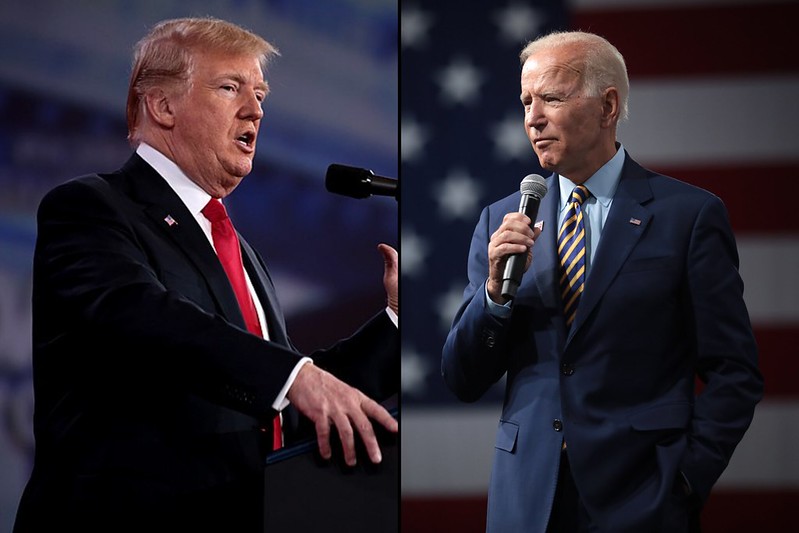
With two presidents – one current and one former – running against each other for the first time since 1912, the 2024 election presents voters with the unique opportunity to compare how Democrat Joe Biden and Republican Donald Trump, who are each likely to get their party’s nomination, actually used the authority of the presidency.
Examining Biden and Trump from this perspective, it’s clear that while they pursued vastly different policies, they often used presidential power in remarkably similar ways.
Both Trump and Biden have tried to achieve their policy goals in ways that avoided having to get Congress’ cooperation. There are a few exceptions, with major legislation passed early in the presidents’ terms when they had a unified government – Trump with the 2017 tax cuts and Biden with the 2021 infrastructure bill and 2022 Inflation Reduction Act.
But more frequently, they aimed to accomplish their objectives either through their power over the executive branch and administrative agencies or in foreign policy, where a president possesses more discretion than in domestic affairs.
Such similarities in men who could not be more different in their political values and policy priorities naturally raise the question: Why do Trump and Biden seem so alike in how they are using presidential power? As a scholar who studies how the constitutional structure of American political institutions effects the authority and behavior of individuals operating within those institutions, I see these similarities as being driven by the fact that, as presidents, they faced the same incentives and constraints.
Policy through executive order
One place where this similarity is particularly evident is in the number and scope of Trump’s and Biden’s executive orders, which recent presidents have used to order administrative agencies to enact particular policies unilaterally.
Through their first three years in office, the two presidents issued a comparable number of executive orders – 127 for Biden and 137 for Trump, often for major policy objectives.
For example, Trump’s infamous 2017 “Muslim ban” restricting the immigration into the U.S. of people from several majority-Muslim countries, as well as immigrants from Venezuela and North Korea, was instituted through two executive orders.
Similarly, Biden’s sweeping effort in 2022 to cancel student loan debt was also initiated through an executive order.
In foreign policy, Trump was able to conclude the Abraham Accords in 2020, normalizing relations between Israel and several Middle Eastern nations. He also unilaterally pulled out of the Paris climate accord in 2017 without congressional input.
When Biden entered office in 2020, he reversed Trump’s action and reentered the Paris climate accord and ended the war in Afghanistan by withdrawing U.S. troops there.
Trouble in the party
One reason for the two presidents’ similar exercise of executive power is the circumstances of their presidencies.
Despite their differences, Trump and Biden have faced many of the same isolating conditions that prevent them from achieving great victories through legislation, which forced them to act in those areas where presidential power is stronger.
While both had unified government in the first half of their terms with their party controlling both houses of Congress, both of their parties were internally fractured.
Trump’s attempt to repeal President Barack Obama’s Affordable Care Act was famously torpedoed by a dramatic thumbs-down from Republican Sen. John McCain.
These Republican fractures became even more evident as Trump’s presidency wore on. One crucial example of this division: Trump was the only president to have members of his own party vote for his removal from office in his two historic impeachments.
Biden has been forced to deal with the consistent threat of potential defections from Democratic Sens. Joe Manchin and Kyrsten Sinema. To get their crucial votes, he had to substantially water down his “Build Back Better” infrastructure bill.
Sinema has since left the Democratic Party to become an independent, and Manchin is exploring a third-party run for president against Biden. The Democrats’ Senate majority is too slim to allow the White House to ignore either of these troublesome senators.
After the midterm elections, both presidents found themselves facing divided government, with the House of Representatives held by the opposing party.
The House in both cases was not afraid to flex its muscle against the president, freely employing its impeachment authority against both of them. They impeached Trump twice and have opened an impeachment inquiry against Biden, which may soon lead to a formal impeachment vote.
The Constitution rules
Both presidents have been similarly unpopular with Americans. According to Gallup, both presidents had an average approval rating of 43% in the third year of their administrations, and this unpopularity has meant that neither Trump nor Biden has been able to effectively utilize the bully pulpit to force change.
In these conditions, it is no surprise that Trump and Biden turned to the one source of power still available to them: the Constitution.
The structure of American political institutions, set up by the Constitution, affects the authority and behavior of individuals operating within those institutions. With that in mind, it is apparent that the policy successes and failures of the Trump and Biden administrations have largely lined up with the powers that the Constitution does and does not give presidents.
With Congress either too obstinate or too polarized to act on the president’s agenda, a president will naturally use the tools that are available to him. The Constitution dictates that those tools are primarily found in administrative actions and foreign policy.
By looking at the Trump and Biden administrations from this constitutional perspective, it’s clear how, despite the hyperpolarization of our politics, the Constitution continues to be influential in the power it grants presidents operating without the cooperation of Congress.
Trump and Biden are very different presidents. Yet, in working from the same constitutional toolbox, they used the means available to their office in similar ways, even in the pursuit of very dissimilar ends.