
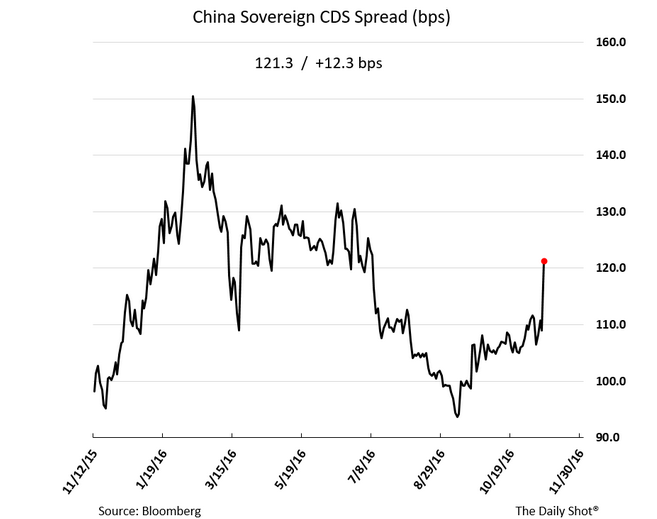
China started trading of credit-default swaps (CDS) on the nation’s interbank market after being faced with rising bond failures. In September 2016 the People’s Bank of China (PBoC) approved CDS trading by financial institutions on the interbank market and ten Chinese financial institutions, mostly banks, conducted the first batch of credit default swap (CDS) transactions on November 1st.
China’s rapidly rising corporate debt on the back of uncontrolled credit-fuelled stimulus poses a major risk to the country’s longer-term outlook. China’s corporate debt which currently stands at 169 percent of GDP triggers concerns regarding corporations’ future debt servicing ability and banking sector soundness. China's Dongbei Special Steel went bankrupt last month after failing to repay its debts of several billion yuan nine times.
Sentiment toward China will remain volatile over the coming months, impacted by corporate debt overhang, developments in the housing market, concerns regarding economic growth and industrial over-capacity, structural reform progress, and authorities’ intervention. The demand for CDS is increasing as risks of defaults grow.
In March 2016, Standard and Poor’s and Moody’s rated China at “AA-” and “Aa3”, respectively with a “negative” outlook on the back of rather slow progress on the economy’s rebalancing. Fitch rates China in the “A+” category with a “stable” outlook.
In Monday's trading, ten institutions including China’s four biggest banks conducted 15 CDS deals with a combined 300 million yuan ($44 million) of notional principal, according to the National Association of Financial Market Institutional Investors (NAFMII) statement. China’s 5-year credit default swap has jumped 15 basis points (bps) to 125 bps since the beginning of November.
USD/CNY was 0.5 percent higher on the day. At around 1130 GMT FxWirePro's Hourly US Dollar Spot Index was at 49.1506 (Bias Neutral). For more details on FxWirePro's Currency Strength Index visit http://www.fxwirepro.com/currencyindex .


