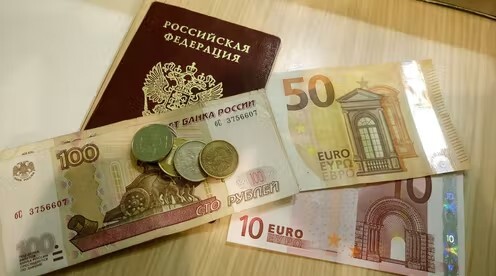
The Russian response to Western sanctions took a rather original form on Monday 7 March: to draw up a list of “hostile” countries and to authorise Russian individuals and companies to repay their debts in roubles, despite the fact that the credit was contracted in another currency.
On this list, we find the countries of not only the European Union, the United States, the United Kingdom, Japan, but also Canada, Switzerland, Monaco and Korea.
The decision of the Kremlin seems in fact quite shrewd and aims to indirectly gain the support of foreign banks.
Double punishment?
Most of the economic sanctions taken against Russia are intended to financially isolate the country. The logic is simple: money is the backbone of the war. Without money, it seems extremely complicated for Russia to be able to continue its action in a sustained manner.
This strategy of undermining the Russian economy is partly working. On February 24, the day of the invasion, the euro/rouble parity rate was 95 (i.e., 1 euro was equivalent to 95 roubles). On Monday March 7, it had risen to 148.38. This means that a Russian who wanted to buy a product for 300 euros in France had to pay 28,423 rubles on February 24, and 44,366 rubles on March 7.
The ability of Russians to trade at the international level is therefore greatly reduced. When we know that the Russians imported nearly 240 billion dollars in 2020 (about 197 billion euros), the bill will increase significantly.
One might think that this devaluation of the rouble would reduce Russia’s export costs to foreign countries, favouring Russian producers on the international scene. However, to counter this potential positive effect, most European countries have decided to boycott Russian exports. For example, they refuse to issue export licenses for certain goods. As a result, the penalty is twofold: imports are decreasing, and exports are being blocked.
What are the traditional solutions to this currency depreciation for Russia? The exchange rate regime of the rouble against other currencies is a so-called floating regime, i.e. it is fixed by the laws of supply and demand on the market. To strengthen the rouble, it would be necessary to increase the demand for it, and thus to increase the number of international financial transactions in rouble… which is deliberately prevented by the sanctions that have been imposed.
What card is left in the hands of the Kremlin? The answer given is imaginative, to say the least: to allow the payment of Russian credits abroad in roubles.
International banks in a bind
In addition to the international trade players, people who have credits with foreign institutions are directly affected by the international sanctions. Let’s say you are Russian, you have borrowed 100,000 euros from a French bank, and you pay back 500 euros every month. As of February 24, this amounted to 47,530 roubles, while the same amount is 74,190 roubles as of March 7. The credit is becoming more and more complicated to repay.
So there is a risk of a massive increase in defaults, causing difficulties for foreign banks. This is precisely the leverage that Moscow intends to use. By allowing Russian debtors to pay for their foreign loans not in local currency but in roubles, the country’s authorities are delegating the maintenance and management of their currency from Russia’s central bank to foreign banks.
Let’s take our example from another point of view: you are a French bank, you hold in your assets 100,000 euros of debt issued by Russian clients, with a monthly repayment of 500 euros per month. As shown above, the repayment value of this loan between February 24 and March 7 is not the same amount in roubles, respectively 47,530 roubles and 74,190 roubles.
In itself, this may not seem problematic for the French bank, since in both cases it recovers the equivalent in value, namely 500 euros. However, the problem is not the value, but the currency. Once owning this amount, the bank has two options. It can decide to keep this money in rouble, but with the significant risk at the moment that it will devaluate again, and therefore that the reimbursements will not be worth 500 euros anymore. Alternatively, it can decide to go to the financial markets to exchange these roubles for euros.
But if everyone tries to convert their roubles at once, this will lead to an even sharper fall in the value of this currency and thus a direct devaluation of the value of the repayment. In both cases, the French bank risks a significant loss of value on its repayments.
The French bank therefore has every interest in ensuring that the rouble/euro parity does not lose more value than it already has. Thus, by taking this decision, Russia has ensured that international banks will seek to indirectly support the Russian economy, in order to avoid seeing their credit devalued.
Some might argue that another possibility for these foreign banks would be to simply refuse payment in roubles. However, this is extremely complicated from a legal point of view because the question arises as to which authority is competent to judge this case and whether the other party to the contract will recognise the legal decision issued, which is not a given. From an economic point of view, this also means increasing the probability of never being repaid should the conflict escalate…