


 BOJ Signals Faster Rate Hikes as Inflation Risks Grow
  RBI Raises Repo Rate to 5.50% in Hawkish Shift on Inflation Risks
  Trump Demands Powell Resign Over Fed Renovation Cost Overruns
  Zcash Mining Profits Surge as Liquidity Risks Grow
  Circle Stock Falls 4% as Crypto Selloff Overshadows SAP Pay Expansion
  RBI Uses $10 Billion Currency Swaps to Drain Excess Rupee Liquidity
  RBA Says ASX Still Falls Short on Governance and Risk Controls
  Fed Unveils Stablecoin Rules Under GENIUS Act
  Fed Unveils Stablecoin Rules Under GENIUS Act
  Fairshake Backs 32 Pro-Crypto House Candidates
  Litecoin Marks 15 Years as Grayscale Backs LTC ETF Push
  Kalshi Withdraws PEPE Perpetual Futures Filing


 Add as a preferred source on Google
The European Central Bank left ultra-loose monetary policy unchanged on Thursday and maintained its monthly QE purchases of EUR80bn. The central bank kept the door open to more stimulus in December, firmly shooting down any talk of tapering its 1.7 trillion euro asset-buying program.
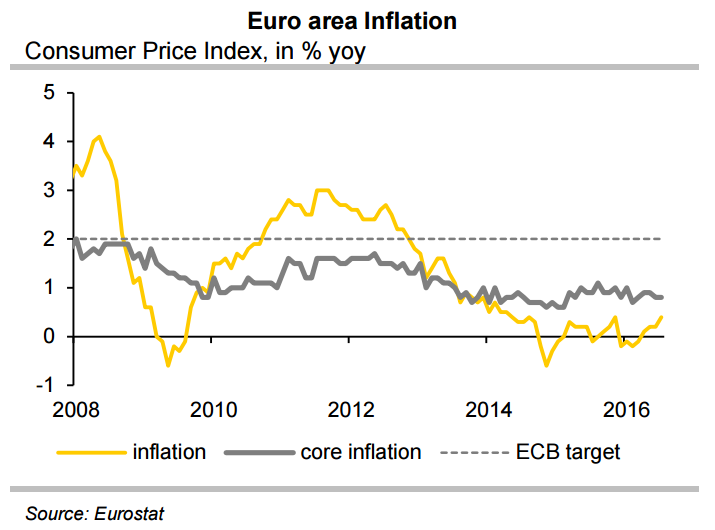
ECB President Mario Draghi did not provide any clues regarding the central bank's next move. Regarding inflation, Draghi emphasized that a long-awaited rise in inflation is predicated on "very substantial" monetary accommodation. However, he said that “there are no signs of a convincing upward trend in core inflation”.
ECB has provided unprecedented stimulus for years with the aim of boosting inflation. The overall inflation rate will rise as a result of base effects (the decrease in the oil price is falling out of the annual rates) over the coming months and can therefore not really be used as the main argument in favour of a more expansionary monetary policy.
It is clear that the ECB only wants to announce an extension of the asset purchasing programme once it can communicate clearly to the market how it will treat the issue of scarcity (the foreseeable limitation of eligible bonds if it extends the purchasing programme) and it will then also have to adjust some of the parameters of the purchasing programme.
"If, as we expect, the ECB extends QE by nine months, we estimate that under the current regulations it would by early summer 2017 no longer be able to find sufficient Bunds suitable for purchase. Consequently, in December the Bank will have no choice but to change the rules of the program," Commerzbank said in a note.
EUR/USD initially rose 0.5 percent to 1.1040 on Draghi's comments that an extension was not discussed but eased back to a four-month low of 1.0921 as markets are increasingly pricing in more easing. The major was 0.39 percent lower on the day, trading at 1.0886 at around 12:40 GMT.







