


 Solana Price Drops 3% Despite Samsung USDC Partnership
  RBA Hikes Interest Rate to 4.60% as Inflation Risks Rise
  Cardano Hits Record 436 TPS as Network Scaling Advances
  RBA Says ASX Still Falls Short on Governance and Risk Controls
  Kalshi Withdraws PEPE Perpetual Futures Filing
  RBI Raises Repo Rate to 5.50% in Hawkish Shift on Inflation Risks
  Bitcoin Price Falls Below $83K as Liquidations Hit $697M
  Kazakhstan and Tether Explore Tenge Stablecoin and RWA Tokenization
  Fed’s Hammack Says Bond Yield Surge Is Not Driven by Inflation Fears
  David Schwartz to Reveal XRP Ledger Future at Ripple Swell 2026
  Dogecoin Liquidations Surge as DOGE Bulls Face Heavy Losses


 Add as a preferred source on Google
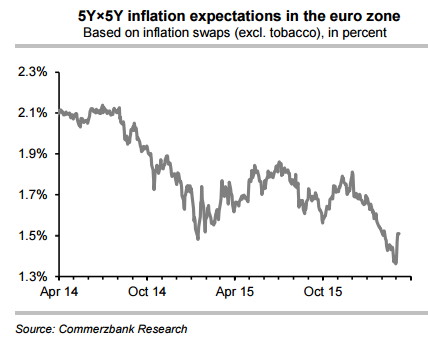
Euroarea headline inflation in February slipped back into negative territory, came in at -0.2% from +0.5% in January. Core inflation unexpectedly plunged 0.3pp to +0.7%, just above the all-time low (+0.6%) reached in January 2015. Since the December meeting, eurozone economic outlook and inflation have weakened, leading indicators have fallen short of expectations. More easing from the ECB on 10 March looks virtually certain. Draghi may not want to repeat the disappointment that took place after the December meeting.
At the March 10th meeting, ECB is expected to lower projections for growth and inflation slightly for the coming years. President Draghi is expected to stress that the ECB's revised inflation profile is surrounded by downside risks since the recent drops in headline and core inflation will likely not be incorporated in the updated projected outlook due to cut-off date reasons.
"The ECB to revise down its 2016 and 2017 inflation forecasts from +1.0% and +1.6% projected in December to +0.4% and +1.4%, respectively. This compares with our revised forecast that inflation is likely to average +0.1% this year and +1.0% next", says Barclays in a research report.
The likelihood of a two-tier system has recently increased from the comments by ECB speakers and the recent increase in lending rates in some countries. The ECB may loosen or remove the deposit rate floor constraint on the purchases in the public sector purchase programme (PSPP) and further broaden the universe of eligible assets than to remove the capital key or bond specific limits.
"News about ECB deliberations ahead of the policy meeting next week indicate growing concern about pushing rates further into negative territory. The focus might be shifting to asset purchases and implementing a tiered deposit rate on excess reserves. This could just be trying to rearrange the deck chairs, as the impact of unconventional policies fade." notes Societe Generale in a report.
Recent indicators suggest that the current modest economic recovery remains driven by domestic demand. February passenger car registrations recorded double-digit annual growth in Germany (+12.1%), France (+13.0%), Italy (+27.3%) and Spain (+12.6%). Euro area retail sales also came in on the strong side in January, beating expectations and advancing for the third consecutive month. Moreover, the latest labour market data for January were reassuring about the euro area private consumption outlook.
"While the outlook for private consumption appears solid, the long-awaited investment rebound may continue to lag, implying downside risks to our expectation that growth will improve +1.6% this year and 1.8% next", adds Barclays.
EUR/USD was trading weaker on the day at around 1.0952 at 1000 GMT, while EUR/GBP was at 0.7740.

- News

- Economy

- Central Banks
- Investing
- Research
- Roundups
- Digital Currency
- Insights
- Technical Analysis
- Technology
- Business
- Law
- Health
- Nature
- Fintech
- Science
- Topic
- Opinions
- ©Econometrics LLC . All Rights Reserved.
ECB to lower projections for growth and inflation at March 10th meet and take further action
Monday, March 7, 2016 10:18 AM UTC
Editor's Picks



- Market Data
Most Popular




