
Euro Zone is facing one of the most diverse economic recovery and labour market. Partial reforms pursued by governments coupled with easy monetary policy from European Central Bank (ECB) has led to the rise in employment across Euro Zone, however any level that can be called as normal remains far off.
As of now inflation is low with thanks to lower oil price, however if inflation do return before fragmentation is removed ECB would face critical policy choices, weather to raise rates to prevent any overheating of stronger economies with lower unemployment rate or to keep easing to bolster growth across the weaker ones like Greece, Spain, Cyprus.
European Central Banks (ECB) and the governments need to coordinate together to pursue reforms in such that economies converge and fragmentation gets reduced.
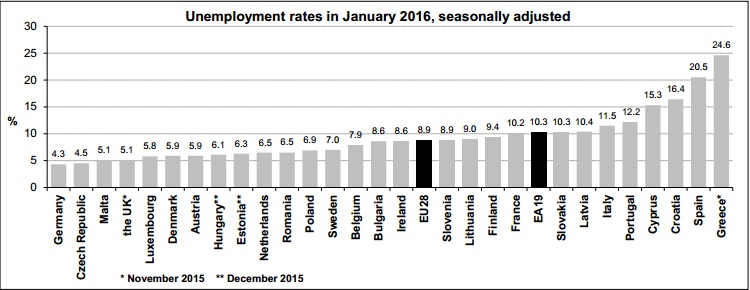
As of latest employment report fragmentation still high, despite improvement in the overall labour market -
- Euro area unemployment rate dropped to 10.3%, which is lowest reading since August 2011. However lot is still to be done as more than 16 million still remains unemployed in Euro area.
- Fragmentation is quite large. While Germany enjoys lowest unemployment rate in the region at 4.3%, Greece and Spain have their rates above 20%.
- Even in France, every one in ten is unemployed.
- Euro area's third largest economy, Italy is suffering unemployment as high as 11.5%.
ECB is likely to take further policy measures on March 10th meeting, which would derail Euro lower. Euro is currently trading at 1.087 against Dollar.

