


 ECB May Stop Rate Hikes After December, Capital Economics Says
  Circle Stock Falls 4% as Crypto Selloff Overshadows SAP Pay Expansion
  Bitcoin Outflows From Binance Hit Three-Year High as Whales Accumulate
  RBA Hikes Interest Rate to 4.60% as Inflation Risks Rise
  Solana User Growth Jumps 33%, Outpacing Ethereum and Chainlink
  BlackRock’s Rick Rieder Favors Bonds Over Stocks as Treasury Yields Surge
  Fed’s Logan Signals 50 Basis Points More in Rate Hikes
  Bitcoin Price Falls Below $83K as Liquidations Hit $697M
  Robinhood Buys $25 Million in Bitcoin for Corporate Treasury
  Trump Demands Powell Resign Over Fed Renovation Cost Overruns
  Litecoin Marks 15 Years as Grayscale Backs LTC ETF Push
  BOJ Raises Interest Rate to 31-Year High as Yen Weakens


 Add as a preferred source on Google
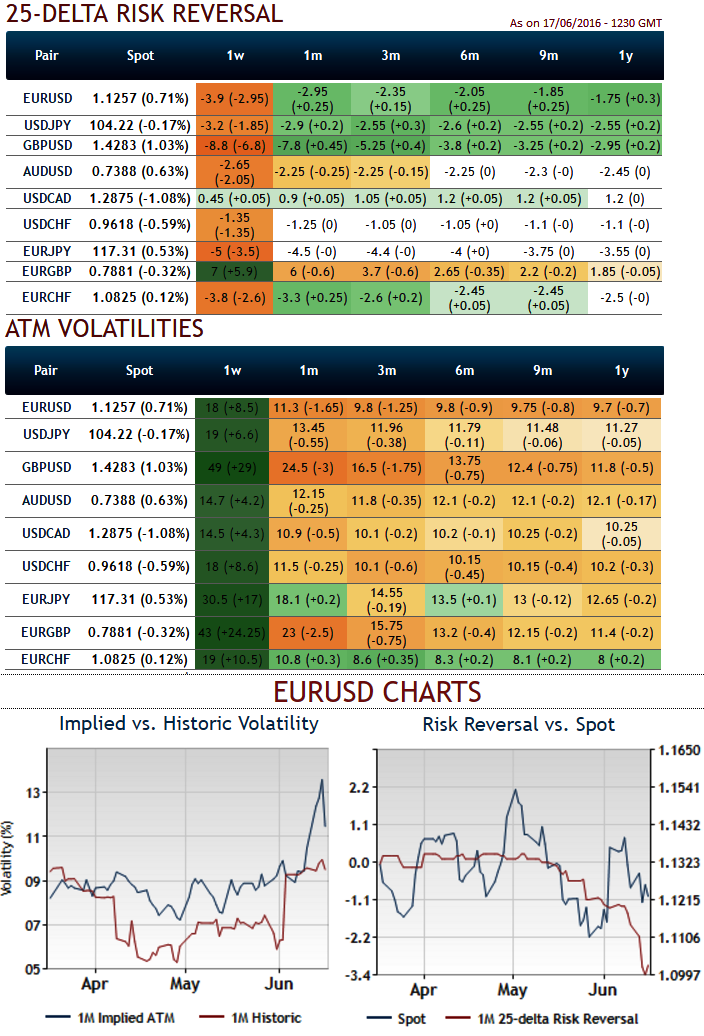
We suggest that offsetting forces and a period of relatively calm central bank activity will push FX volatility down in H2. Major central banks such as BoJ, RBA, RBNZ and the ECB face strong internal resistance to deeper rate cuts, and on Fed and BoE are on the other corner whose policy actions have been deferred on account of the global slowdown and Brexit pressures respectively, not least from banks and insurance companies.
On its side, the Fed will not want to upset the apple cart. FX volatility, of course, is unlikely to fall before the UK referendum, and if the UK decides to stay in the EU, we will recommend selling FX volatility.
Realized volatility is likely to continue falling and implied should follow. We, therefore, recommend buying a 6m EUR/USD double no-touch option with barriers delimiting the range. This option is short vega, and with the spot not being in the middle of the range but close to one of the knock-out barriers, it currently offers significant leverage.
As central bank activism should begin with slowness in H2, EUR/USD is unlikely to break its range and volatility is set to shrink away as shown in IV nutshell.
Trade recommendation1: Shorting FX implied vol during early stages of H2 using OTM options of USDJPY and EURUSD is a smart approach that would likely perform in an environment of falling volatility as suggested in our previous write up on the negative risk reversals.
Likewise, in our trade recommendation 2, AUD/USD barrier option is short vega, as we expect the spot to fall gradually rather than collapse.
Buy EUR/USD 6m double no touch, knock-out 1.09-1.16, indicative offer: 10-15% (spot ref: 1.13)
Risks: Limited to the premium. Investors buying a double no-touch option cannot lose more than the premium initially invested. However, it will be knocked out if EUR/USD hits 1.09 or 1.16 at any time before the 6m expiry.







