


 Bitcoin Rebounds to $82K as Crypto Market Faces Weekly Losses
  European Stocks Rally on Chinese Growth and Mining Merger Speculation
  Solana Price Drops 3% Despite Samsung USDC Partnership
  Urban studies: Doing research when every city is different
  Global Markets React to Strong U.S. Jobs Data and Rising Yields
  Chainlink Price Drops 3% Despite New CCIP Vault Launch
  David Schwartz to Reveal XRP Ledger Future at Ripple Swell 2026
  Indonesia Surprises Markets with Interest Rate Cut Amid Currency Pressure
  Zcash Plans Quantum-Resistant Security Upgrade for January
  UBS Predicts Potential Fed Rate Cut Amid Strong US Economic Data
  U.S. Treasury Yields Expected to Decline Amid Cooling Economic Pressures
  US Futures Rise as Investors Eye Earnings, Inflation Data, and Wildfire Impacts
  China's Refining Industry Faces Major Shakeup Amid Challenges
  U.S. Stocks vs. Bonds: Are Diverging Valuations Signaling a Shift?


 Add as a preferred source on Google
The Australian inflation data for Q2 provided a considerable dampener for the rate cut speculation this morning.
The inflation measure preferred by the Australian central bank (RBA), the trimmed mean, remained surprisingly stable at 1.7% YoY.
That means, at least on the inflation front the RBA does not see any urgent need for action. The rise of AUD since late May, on the other hand, is likely to be a reason for concerns for the central bank. That means the door has not been completely shut on a rate cut yet.
On the flip side, This week is a busy one for Japan data watchers with many June releases including CPI, housing starts, and FX markets digesting the better than forecasted trade balance data, while the key focus should be on Friday’s BoJ policy meeting.
If it is judged necessary for achieving the price stability target” (from June Statement on Monetary Policy). The economy has struggled with deflation for two decades. Even after the BOJ's massive qualitative and quantitative easing (QQE) program and venture into negative interest rates territory, the Asian economy hasn't been able to boost domestic consumption and shake off deflation.
Hedging Framework: Capitalize on rallies and HY vols likely to favour PRBS
AUDJPY has consistently been sliding in a sloping channel as selling momentum is intensified as the monetary policies adding extra impetus to the selling pressures, so the foreign traders who have their export or import bills should be hedged by below option strategies.
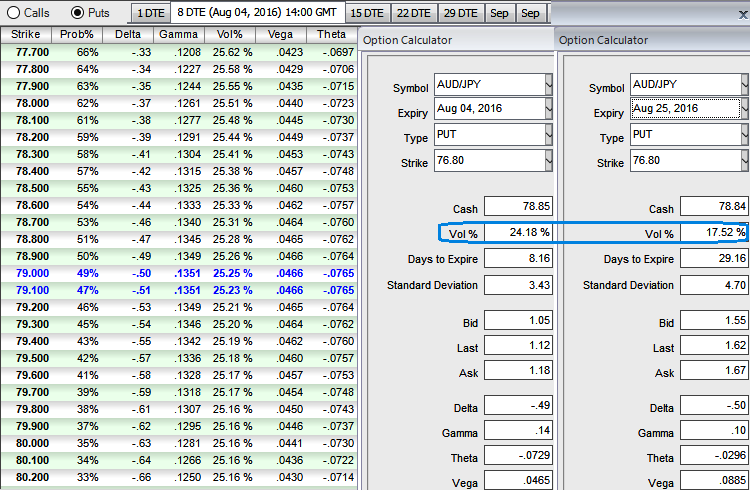
ATM IVs of 1w expiries are flashing at 24.18% and 17.52% for 1m tenor.
While IVs of ATM contracts of 1w and 1m tenors are spiking crazily and this has been justified by historical volatilities in spot FX fluctuations (see big real body candles on monthly technical charts).
Traders tend to view the put ratio back spread as a bear strategy because it employs puts. However, it is actually a volatility strategy. The implied volatility of 1M ATM put contract is at 17.52% and it is quite higher side when long-term trend is bearish.
Traders tend to view the put ratio back spread as a bear strategy because it employs puts. However, it is actually a volatility strategy.
Options with a higher IV cost more. This is intuitive due to the higher likelihood of the market 'swinging' in your favour.
As we expect the underlying currency exchange rate of AUDJPY to make a larger move on the downside. As shown in the figure purchase 1M 2 lots of At-The-Money -0.52 delta puts and sell 1W one lot of (1%) In-The-Money put option.







