
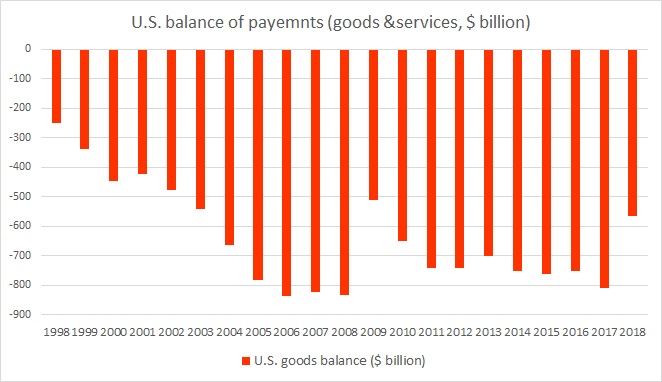
U.S. President Donald Trump’s name is now synonymous with the global trade war. President Trump has unilaterally waged a war against U.S trade deficits by forcing countries to engage in new trade negotiations with the United States. He also delivered his promise of tax cuts to the U.S. economy. However, while the effects of his policies are quite visible in the strength of the U.S. GDP growth, U.S. manufacturing sector, it is still absent in the trade numbers.
President Trump successfully negotiated a new trade agreement with several countries like China, Mexico, and Canada and has also imposed tariffs on several imports like Steel and Aluminum with additional tariffs on Chinese goods worth $250 billion.
However, the effect is still not visible in hard numbers.
In August, the United States’ goods trade deficit hit the widest on record of $75.46 billion and in 2018, it has already reached $565.6 billion. At this pace, the United States would record the widest trade deficit ever. The deficit is projected between $840-850 billion.
After so much of a trade and tariff war, a failure to curb the deficit would prove to be dollar negative. Since trade numbers take a lot to reflect the changes, we suggest waiting out 2019, since higher tariffs on Chinese goods would begin from January.

