


 Fed’s Hammack Says Bond Yield Surge Is Not Driven by Inflation Fears
  RBI Uses $10 Billion Currency Swaps to Drain Excess Rupee Liquidity
  China’s Growth Faces Structural Challenges Amid Doubts Over Data
  Trump Demands Powell Resign Over Fed Renovation Cost Overruns
  China's Refining Industry Faces Major Shakeup Amid Challenges
  Mexico's Undervalued Equity Market Offers Long-Term Investment Potential
  Fed’s Williams Sees One More Rate Hike in 2026, None in 2027
  Australia Consumer Confidence Plunges as RBA Rate Hike Hits Households
  ECB May Stop Rate Hikes After December, Capital Economics Says
  Energy Sector Outlook 2025: AI's Role and Market Dynamics
  U.S. Stocks vs. Bonds: Are Diverging Valuations Signaling a Shift?
  Fed Unveils Stablecoin Rules Under GENIUS Act
  Urban studies: Doing research when every city is different


 Add as a preferred source on Google
Sell a put against existing cash short in EURSEK. Stay short NZDSEK in options The structural case for SEK appreciation remains intact the real effective exchange rate is 10-11% below its long term average despite an economy that has a positive output gap and which continues to deliver above-trend growth. This week it was reported that Q4’16 GDP jumped by 4.2%.
In addition we upgraded our forecast for Q1’17 from 3.0% to 4.0% (the Riksbank expects 3.2%). The problem for SEK is not the economy but rather monetary policy which is still myopically fixated on delivering at-target core inflation.
A central plank of the central bank’s strategy is too impede a fundamentally justified appreciation in SEK for as long as it can, which is why we expect only a relatively slow pace of SEK appreciation. In order to better reflect the outlook for a slow grind higher in SEK we are converting our cash short in EURSEK into a covered put.
This serves to improve our entry level by around 0.5% and provides some positive time decay as SEK is prone to consolidate in the four weeks between the only data point that matters for Riksbank, CPI. EURSEK vols like all euro pairs are elevated as result of the French election premium so there’s added value in selling lower-strikes in EURSEK at this juncture. 3-mo implied vol of 6.65% compares to realized vol of only 4.9%.
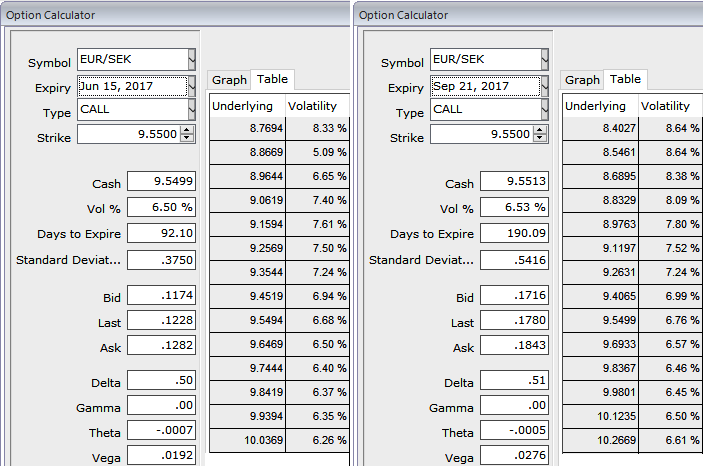
Sell a 3-mo EURSEK put, strike 9.35. Receive 0.52%. Spot reference 9.5533.
Sold EURSEK at 9.4847 on January 13. Stop at 9.6850. Marked at -0.54%.
Bought a 6-mo NZD put/SEK call, strike 6.10 for 1.47%. Spot reference 6.2372. Marked at 0.42%.







