


 NEAR Price Surges 11% as Trading Volume Doubles
  Global Markets React to Strong U.S. Jobs Data and Rising Yields
  Stock Futures Dip as Investors Await Key Payrolls Data
  Gold's Tug-of-War: Geopolitical De-escalation Fights Falling Yields as Markets Eye US CPI
  Ripple Mints 19.6 Million RLUSD Amid Banking Expansion
  Lithium Market Poised for Recovery Amid Supply Cuts and Rising Demand
  UBS Predicts Potential Fed Rate Cut Amid Strong US Economic Data
  China's Refining Industry Faces Major Shakeup Amid Challenges
  U.S. Treasury Yields Expected to Decline Amid Cooling Economic Pressures
  Gold Prices Slide as Rate Cut Prospects Diminish; Copper Gains on China Stimulus Hopes
  XRP Price Drops 3% Despite Ripple-Backed Evernorth Nasdaq Debut
  Goldman Predicts 50% Odds of 10% U.S. Tariff on Copper by Q1 Close


 Add as a preferred source on Google
If 2020 is a year in which the reflation trade becomes as dominant as in 2017, NEER depreciation could be large. The decline could be even larger than in 2017, given that in that year, the JGB 10-year yield was positive, as was the carry from investing in FX-hedged 10-year US treasuries. We also note that Japan’s trade surplus was still around 1% of GDP. By contrast, Japan’s trade surplus will be essentially flat next year. Two other factors could contribute to sustained outflows, depressing the NEER:
JGB 10-year yields were still positive in 2017 and 2018, after the BoJ introduced its yield curve control policy. However, from early 2019, yields entered negative territory, and remained negative for the most part. This episode of negative rates has already outlasted that of 2016 when yields first dipped below zero; Japanese investors are finding themselves in an unprecedented period of negative yields.
Around JPY50 trillion of JGBs held by investors other than the BoJ is set to mature in 2020, against only JPY11 trillion yen of positive yielding ultra-long-term bonds.
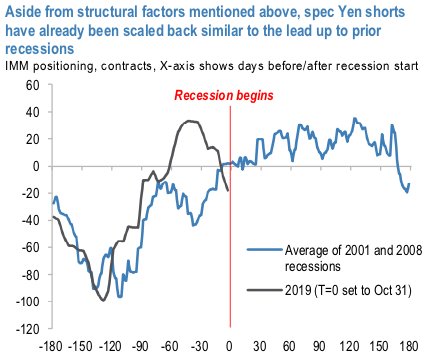
The global downturns have typically prompted JPY appreciation, current positioning suggests less favorable conditions for rapid JPY strength even if US recession fears re-intensify in 2020. While there is no denying the possibility of a global recession leading to relatively large Yen appreciation, we think rapid JPY appreciation is less likely even if concerns over a 2020 US recession intensify.
One reason for the Yen’s appreciation when entering a global recession is that investors with speculative JPY short positions face increased volatility and buy back JPY to close their short positions; we note that there was a rapid reduction in speculative Yen shorts leading into the start of the 2008-09 recession in particular, as market recession expectations were re-aligned (refer 1st exhibit).
OTC outlook: The positively skewed IVs of 3m tenors are signifying the hedging interests for the bearish risks (refer 2nd exhibit). The bids for OTM puts expect that the underlying spot FX likely to show further dips so that OTM instruments would expire in-the-money (bids up to 119.50 levels).
Most importantly, to substantiate the above indications, we could see some minor positive shifts in existing bearish risk reversal (RR) set-up of EURJPY that indicates the long-term hedging sentiments across all tenors are still substantiating bearish risks amid minor abrupt upswings in the short-term (refer 3rd exhibit). Please be noted that 3m negative RRs suggest the overall OTC hedging sentiments for the further bearish risks. Hence, we advocate below hedging strategy contemplating the current OTC indications.
Options Strategy: Contemplating above factors, we’ve advocated buying 3m EURJPY (1%) ITM -0.79 delta puts for aggressive bears on hedging as well as trading grounds as the mild abrupt upswings were contemplated earlier.
Short hedge: Alternatively, we advocated shorts in futures contracts of far-month tenors with a view to arresting potential dips, since further price dips are foreseen we would like to uphold the same strategy by rolling over these contracts for March month deliveries. Source: Sentry, JPM & Saxobank







