
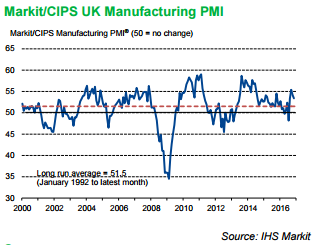
Manufacturing sector of Germany slightly deteriorated amid slower increases in the production output as well as new orders.
The seasonally adjusted final Markit/BME Germany Manufacturing Purchasing Managers’ Index (PMI) fell to 54.3 in November, from October’s 33-month high of 55.0. Still, the reading signalled ongoing growth of German manufacturing in November. Moreover, the PMI remained above its average for 2016 so far (53.0).
November saw new order intakes rise at a solid pace. Despite slowing slightly since October, the pace of expansion was robust with panelists commenting on rising demand from both the domestic and foreign markets. In response to increased new business, companies scaled up their production in November. However, the pace of expansion slowed since the prior month and was the least marked since May.
Manufacturing employment was raised further in November as companies tried to boost capacity. Although the rate of job creation slowed since October, it remained among the strongest over the past five years.
On the price front, latest survey results pointed to the most marked increase in input costs since March 2012. Solid production growth meanwhile resulted in a stabilisation of post-production inventories. Prior to October, stocks of finished goods had fallen for two consecutive years.
"Although the PMI dipped slightly from October’s 33-month high, the average reading over the fourth quarter so far was in fact the best since early-2014, thereby suggesting that the sector should have a positive contribution to GDP growth at the end of the year," said Oliver Kolodseike, Economist, IHS Markit.
Meanwhile, the EUR/USD currency pair is trading 0.33 percent higher at 1.06 and has formed 'closing Marubozu', while at 10:00GMT, the FxWirePro's Hourly Euro Strength Index remained slightly bullish at 82.82 (a reading above +75 indicates bullish trend, while that below -75 a bearish trend). For more details, visit http://www.fxwirepro.com/currencyindex

