


 Hims & Hers Shares Fall as GLP-1 Costs Widen Q2 Loss
  US-Backed Pediatric HIV Treatment Drops After Foreign Aid Changes, Study Finds
  Novo Nordisk Eyes Turnaround as Oral Wegovy Challenges Eli Lilly in Weight-Loss Drug Race
  Eli Lilly Eyes AtaiBeckley Acquisition to Expand Psychedelic Mental Health Pipeline
  GSK Unveils $2.52 Billion Cost-Cutting Plan to Accelerate Drug Pipeline
  Novartis Shares Plunge After Muscle Drug Fails Phase III Trial
  FDA Investigates New Cyclospora Outbreak as U.S. Cases Continue to Rise
  Novo Nordisk Strikes €1.17 Billion Nanexa Drug Delivery Deal
  Trump Administration Bars U.S. Travelers From Congo Flights Amid Ebola Outbreak
  AstraZeneca Q2 Earnings Beat Forecasts as Oncology Growth Supports 2026 Outlook
  SK Biopharmaceuticals Secures Global Rights to Biohaven Epilepsy Drug Opakalim
  New York Declares Measles Disaster Emergency as Cases Surge
  U.S. Issues Cuba Health Alert as Illnesses Rise


 Add as a preferred source on Google

While no country claims to be pursuing herd immunity as a strategy, some – such as Sweden – have taken a more relaxed approach to containing the coronavirus. So how has the relaxed approach fared for Sweden – is it close to achieving herd immunity? How does it compare with other European countries that took more restrictive measures?
Herd immunity is the idea that if a certain portion of the population is immune to an infectious disease, then the disease will stop spreading, without needing the whole population to have been infected. However, herd immunity requires the infection – or a vaccine, which we don’t have yet – to generate a lasting immune response that protects against reinfection. It is not known if this will occur for COVID-19, though it is likely.
Studies have shown that infection with the SARS-CoV-2 coronavirus, or a candidate vaccine, generates an antibody response, though it’s not known if those antibodies prevent reinfection. Studies have also shown that people’s immune response to the related SARS virus were protective and lasted for up to two years, suggesting that the same may be possible for SARS-CoV-2. As a public health strategy, governments have hypothesised that allowing the virus to infect the healthy portion of the population would generate the crucial herd immunity that would then protect people at high risk of severe infection.
This concept relies on shielding the high-risk groups from infection while slowing the spread of the virus to avoid overwhelming the healthcare system. The attraction is that this strategy would not involve locking down the population and would, in theory, allow for a quicker resolution of the country’s outbreak.
Poster child for herd immunity
Sweden has been the poster child for herd immunity, even if it isn’t the country’s official policy. While other Scandinavian countries used lockdowns and broad public restrictions to stop the spread of COVID-19, Sweden opted for more mild interventions and personal responsibility to slow the spread. Unfortunately, their interventions have resulted in significantly higher numbers of cases and fatalities, as seen in the figure below.
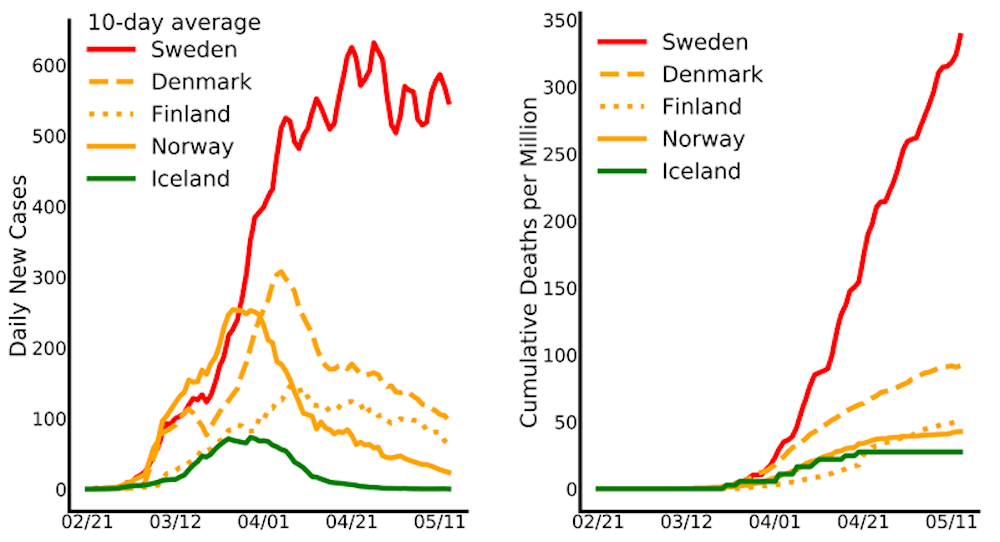
Created by Derrick VanGennep and Vincent Brunsch of EndCoronavirus.org on 14 May 2020 from data at https://github.com/CSSEGISandData/COVID-19.
Sweden has also been criticised for not doing enough to protect the elderly and high-risk groups in the country. But with the high rate of viral spread in the country, is Sweden closer to achieving herd immunity and the end to their outbreak?
Antibody testing in Europe
One way to find out how many people in a population have been infected with SARS-CoV-2 is by conducting a seroprevalence survey. These surveys take blood samples and look for the presence of antibodies against the virus to see who in a representative sample of a population has had the disease. Several countries in Europe have performed these surveys.
In the densely populated city of Stockholm, only 7.3% of the population were seen to have antibodies to COVID-19, with a lower percentage likely as an average for the whole country.
Spain reported a national average of 5% positive for COVID-19 antibodies, with 11% in the city of Madrid and 7% in Barcelona. In the UK, recent numbers from an Office for National Statistics survey suggests that the UK also has a national average of 5% that rises to a high of 17% in London.
The WHO recently estimated that, worldwide, the numbers of people with antibodies to COVID-19 is even lower and is thought to be less than 3%.
No country is known to have more than 5% of their population with antibodies to COVID-19, including countries that have been more supportive of a herd immunity approach.
For COVID-19 it is estimated that achieving herd immunity would require at least 60% of the population to have protective antibodies. Every country is a long way off from this point. With nearly 5.8 million COVID-19 cases around the world and over 358,000 deaths, waiting for herd immunity would cause hundreds of thousands of additional deaths.
Importantly, waiting for herd immunity is not necessary. Many countries around the world have reduced viral transmission to the level of fewer than 100 cases per day. Even China and South Korea have reopened their economies and now see more cases imported into the country than arising domestically. This level of viral control requires continued testing, tracing and isolation of infected people, but containment is possible.
Through continued containment, we can save lives while we wait to achieve herd immunity through the only safe and realistic way possible: vaccination.







