
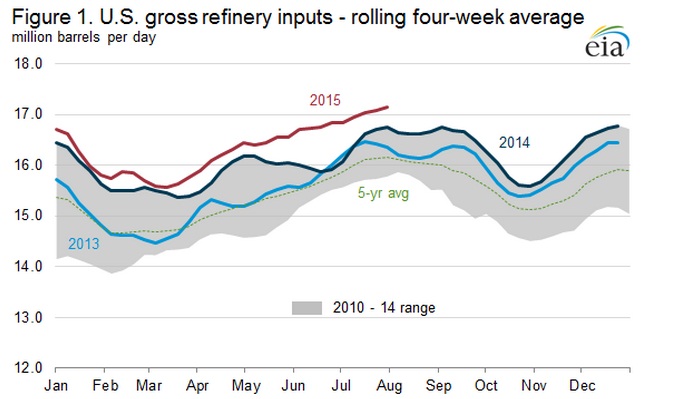
US refineries are operating very close to 100% capacity in a bid to gain from higher crack spreads prevailing across globe, thanks to lower crude prices.
What is crack spread?
- Roughly speaking, crude oil is not consumed in its raw form, instead it is refined in the refineries producing various products such as gasoline, Diesel etc. Price differential between raw crude price and the price of the end products are called crack spread. This is refinery margin, higher leads to higher profits for refineries.
With crude oil prices close to lowest in more than 6 years, and healthy demand from end users led to high global crack spread.
For example, this year on July 8th, Gasoline crack spread touched $0.66/barrel, which is highest since 2008. It has moderated somewhat since then, still enough for refineries to operate at high capacity.
US refineries are consuming more than 17 million barrels/day for past few weeks, while operating capacity stands at 18 million barrels/day.
Going ahead one concern remains that if the crack spread falls, US refineries might reduce their operating capacity leading to faster storage buildup and even spillover at Cushing, Oklahoma.


