
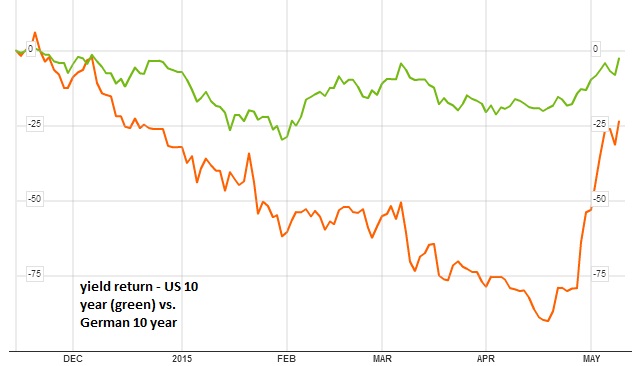
Euro zone bond yields have risen the fastest, compared to other developed market counterparts.
Obvious reason for such is extremely one sided positioning in Euro zone bonds especially German bunds. While a sudden rush for exit might be creating such heavy price swings and high volatility.
However fundamentally speaking inflation poses greater risk for Euro zone than US and one might assume that it might be behind this sudden bond rout.
Why inflation is a greater threat to Euro zone?
- European Central Bank's (ECB) asset purchase program has pushed Euro to its lowest level in a decade making Euro zone countries extra vulnerable to rising energy prices. Euro zone imports most of its energy needs from outside making it vulnerable to inflation importing. Moreover energy inflation is called bad inflation, which Mario Draghi might not be looking for.
- ECB has just started its bond purchase program on March 9, 2015. Higher inflation will increase debate inside governing council over the purchase program that leaves ECB with two dilemma. Continuing bond purchase amid inflationary environment would pose risk of striking higher inflation and ECB to fall very behind the curve and cutting short the purchase program might derail the recovery seen in recent past.
Euro and Euro zone fixed income traders should keep sharp eye on European inflation indicators and commentaries from ECB and its vocal critique German Bundesbank. Euro is currently trading at 1.123, driven by bund yields.


