
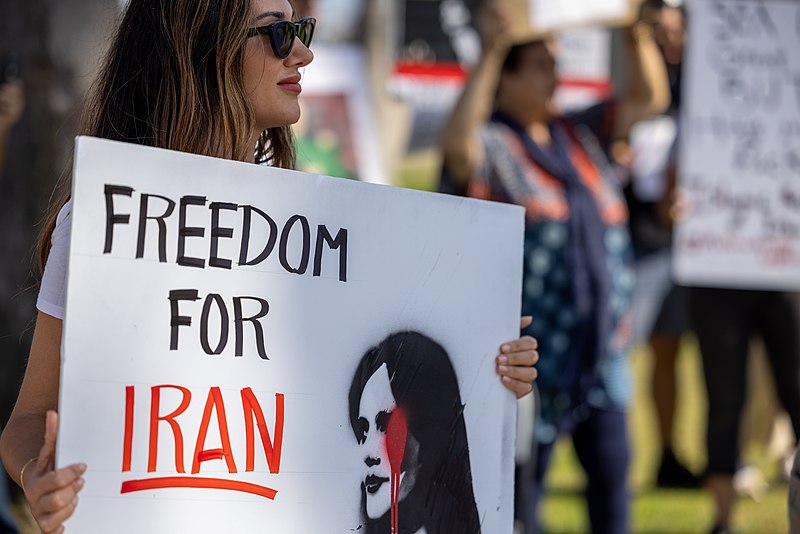
Iran has been in a state of unrest for more than a month with ongoing anti-government protests that mark the biggest show of opposition in years. With Tehran seeking to blame foreign governments for the unrest, it has blacklisted European Union officials and entities over their support for the protests.
The Iranian foreign ministry said Wednesday that it has sanctioned 12 individuals and eight organizations for their support of the protests, which Tehran deems as “inciting terrorism.” The sanctions include an entry and visa ban for the targeted individuals and the seizure of assets they may have in Iran.
While most of the sanctions were related to the recent anti-government demonstrations, some of the penalties imposed by Tehran are also related to Iran’s grievances with the bloc’s officials and member countries over issues that are the center of long-running disputes.
Among the organizations targeted are Friends of Free Iran and the International Committee in Search of Justice – two informal groups in the European Parliament, Stop the Bomb – an organization advocating for sanctions on Iran to prevent Iran from obtaining nuclear weapons, the Persian language service of Germany’s Deutsche Welle and France’s RFI – in another effort by Tehran against foreign channels that it deems as “promoting terrorism” in the country.
Two directors of the German newspaper Bild were also blacklisted by Tehran, as well as the Karl Kolb and Rhein Bayern Farhzeugbau companies for “delivering chemical gases and weapons” to the late Iraqi leader Saddam Hussein, who Iran claims to have used them against the Islamic Republic during Iraq’s invasion of the country back in 1980.
The anti-government protests were sparked by the death of Kurdish Iranian woman Mahsa Amini in the custody of the Islamic Republic’s morality police. Amini died three days after she was detained by the morality police for “improper attire,” sparking public outrage.
Iranian security forces have clashed with people participating in the memorial for Amini, according to the semi-official news outlet ISNA, with thousands of people gathering in Amini’s hometown of Saqqez to mark 40 days since her death. The outlet also said that following the clashes between people and security forces, internet restrictions were put in place.


