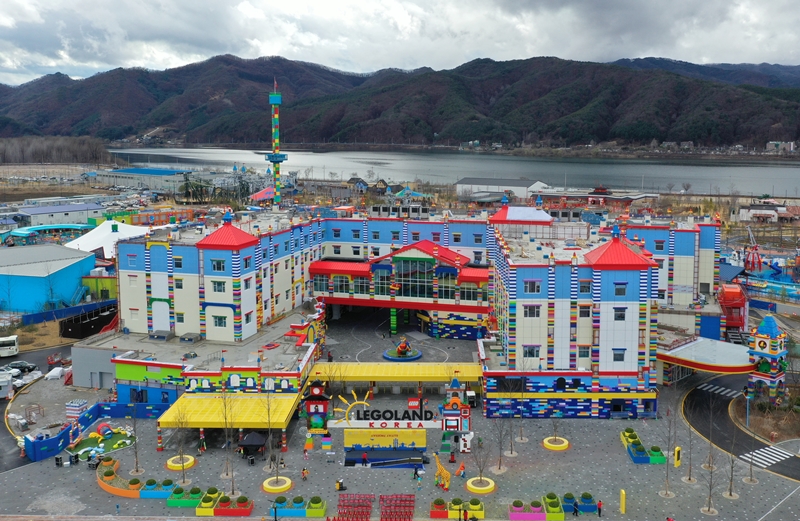
A project financing default for the Legoland Korea amusement park construction in Gangwon Province has triggered a series of problems that made it more difficult for big businesses to raise money, according to industry officials.
The financing woe caused concerns over the possibility of a series of bankruptcies of securities firms and builders.
Before the Gangwon provincial government created distrust in the bond market by breaching its promise to guarantee the repayment of the amusement park developer's debts, affiliates of the SK, Lotte and Hyosung groups raised money through primary collateralized bond obligations (P-CBOs) guaranteed by the state-run Korea Credit Guarantee Fund (KODIT).
As the P-CBO has been used mainly by small- and medium-sized enterprises (SMEs) with lower credit ratings, its issuance by major business conglomerates has been interpreted widely as proof of setbacks in raising capital.
Despite the high credit ratings of LG Uplus and Hanwha Solutions, large proportions of their issued corporate bonds remained unsold,
Those issued by state-owned companies, such as Korea Electric Power Corp., Korea Gas Corp., Korea Hydro & Nuclear Power Corp., and Korea Expressway Corp. also failed to attract institutional investors.
Amid the liquidity crunch, Lotte E&C borrowed 500 billion won from its affiliate, Lotte Chemical, and sold 200 billion won in newly issued shares to the chemical firm, igniting concerns over its financial stability.
According to ana Securities analyst Kim Sang-man, while conglomerates are unlikely to go bankrupt, they will face difficulties in fundraising at least in the short run.
Kim added that the market conditions will weigh further on small and mid-sized businesses already burdened with significant debt since the start of the COVID-19 pandemic.
A survey of the nation's 600 largest companies in terms of sales showed that their outlook for fundraising by the Federation of Korean Industries' (FKI) was worse than the forecasts for profitability, investments, exports, domestic consumption, employment and inventory, due to rising interest rates and falling stock prices.