


 European Stocks Fall as Oil Rises Ahead of Fed Minutes
  Wall Street Falls as Fed Minutes Signal Another Rate Hike
  Trump Opens Tax-Exempt Dyed Diesel Access as Fuel Prices Surge
  Fed Minutes Signal Another Rate Hike by Year-End
  Ethereum Price Drops Below $2,600 as Long Liquidations Hit 4-Month High
  Fed’s Hammack Says More Data Needed Before Next Rate Move
  JPMorgan CEO Jamie Dimon Warns Mythos AI Raises Cyber Risk Tenfold
  US-Led Coalition Targets Global Factory Overcapacity
  Cardano Price Eyes $0.30 as ADA Whale Activity Surges
  Solana User Growth Jumps 33%, Outpacing Ethereum and Chainlink
  Strategy’s STRC Nears $100, Raising Prospects for Major Bitcoin Buys
  Kalshi Withdraws PEPE Perpetual Futures Filing


 Add as a preferred source on Google
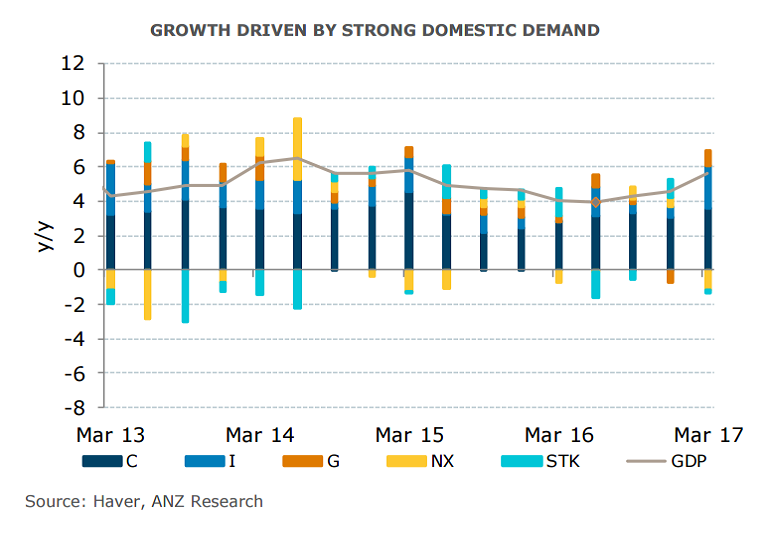
According to data released by Malaysia’s Department of Statistics, Malaysia’s gross domestic product (GDP) grew well beyond expectations in the first three months of 2017, powered by the manufacturing and services sectors. Malaysia’s economy expanded at 5.6 percent y/y in Q1, beating estimates of 4.8 percent from economists polled by Reuters. On a quarter-on-quarter seasonally adjusted basis, GDP grew 1.8 percent, faster than the 1.3 percent registered in the preceding quarter.
Growth was largely driven by private consumption, which rose 6.6 percent y/y and contributed 3.6 percentage points (ppt) to headline GDP growth. Growth in manufacturing accelerated to 5.6 percent from 4.7 percent in the previous quarter, while services rose 5.8 percent. Gross fixed capital formation also surged 10 percent y/y. In all, final domestic demand (including inventories) contributed 6.8 ppt while net exports subtracted 1.2 ppt from headline growth.
Annual consumer price inflation hit an eight-year high in March at 5.1 percent, though it slowed to 4.4 percent in April. The Bank Negara Malaysia (BNM) has said inflation averaged at 4.3 percent in Q1. Higher oil prices was seen as the main driver behind the spike in inflation. BNM Governor Muhammad Ibrahim said that the central bank still expects inflation to come in at 3-4 percent. He noted that there is some uncertainty in global markets, but added that inflation is largely cost driven and not due to demand.
"At this juncture, growth dynamics, though improving, do not point to the emergence of strong demand pull inflationary pressures. Hence, there is limited pressure on Bank Negara Malaysia (BNM) to hike rates," said ANZ in a report.
Malaysia's current account surplus narrowed to MYR5.3bn in Q1, from MYR12.3bn in Q4 2016. This continues against the backdrop of a narrower goods account balance surplus of MYR25.3bn (Q4 2016: MYR31.4bn) and widening service (MYR6.2bn) and income deficit (MYR13.8bn). Consequently, the current account surplus narrowed to 1.6 percent of GDP in Q1 from 3.8 percent in the preceding quarter.
"A recovery in commodity prices should help bolster the current account surplus in the coming quarters, though the surplus is still likely to remain low by past standards," Capital Economics said in a note.
The ringgit, one of the region's worst performing currencies, in 2016, has strengthened about 3.7 percent against the dollar so far this year. USD/MYR was trading at 4.3205 at the time of writing, down 0.13 percent on the day. Price action has broken below major 200-DMA support at 4.3281 and technical indicators support further downside in the pair.







