


 US-Led Coalition Targets Global Factory Overcapacity
  US Treasury Yields Ease After Strong 10-Year Auction as Global Bonds Struggle
  US Dollar Hits 18-Month High as Fed Signals More Rate Hikes
  Oil Prices Trim Gains After Trump Rules Out Iran Strikes Before Midterms
  Bangladesh GDP Growth Accelerates to 4.6% on Industrial Rebound
  Crypto Market Selloff Wipes Out $100B as Bitcoin Falls Below $83K
  US, EU Push for Action Against Asia’s Excess Factory Capacity
  Mike Rogers Calls for End to US-Canada Tariff War
  Wall Street Falls as Oil Prices Rise and Tech Stocks Slide
  Deutsche Bank CEO Urges Faster German Economic Reforms


 Add as a preferred source on Google
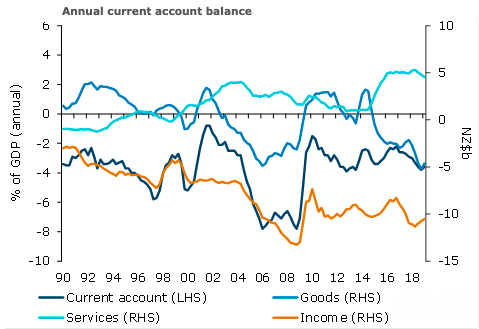
New Zealand’s annual current account deficit narrowed $0.6 billion from an upwardly revised Q4 to $10.6 billion in Q1. This saw the current account deficit as a share of GDP narrow from 3.8 percent to 3.6 percent, which is in line with its historical average.
As is typically the case, the unadjusted quarterly current account transitioned from deficit in Q4 to surplus in Q1 (from -$3.5 billion to $0.7 billion). This was slightly larger than the $0.2 billion surplus we had pencilled in. Much of the variance seems timing related, with revisions appearing to capture a large chunk.
The goods deficit flipped into surplus, reflecting an unwinding in seasonal import demand over the summer months and as exports remained robust on the back of still-high prices and solid agricultural production in recent quarters.
While the OTI terms of trade suggest goods export prices did indeed fall in Q1, this was by less than the decline in import prices, with the net impact on the trade balance being positive.
The unadjusted services surplus widened from $1.0 billion in Q4 to $3.0 billion in Q1 as imports dipped (fewer kiwis go on overseas holidays when the weather back home is good) and exports lifted, reflecting the usual seasonal peak international tourism demand.
In seasonally adjusted terms, the current account deficit was broadly stable in Q1, narrowing by just $60 million. A smaller goods deficit (on slightly softer imports) was offset by a smaller services surplus, which shrank by around $0.1 billion on the back of higher services imports.
As expected, New Zealand’s net international liability position (NILP) improved (by $4.0 billion to $164.4 billion), largely reflecting a rebound in the value of offshore assets following Q4’s downward revaluation on the back of the global equity wobble late last year. As a share of GDP the NILP fell 1.9 percentage points to 55.5 percent.
Image courtesy: ANZ Research







