
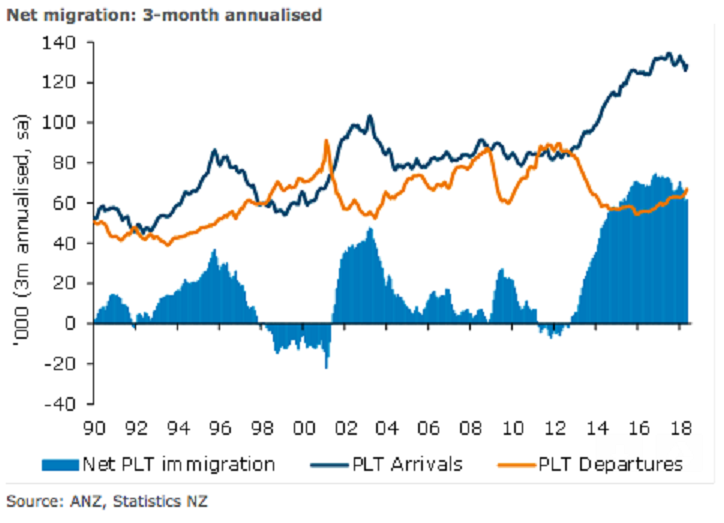
New Zealand’s monthly net migrant inflows continued to trend downwards, but ticked up on last month as arrivals bounced while departures continued to lift. Short-term visitor arrivals lifted and continue to hold at elevated levels. Strong migration-led population growth has been a key driver of economic activity this cycle and with net migration well and truly past its peak, the impetus to GDP growth is shrinking, ANZ Research reported.
Permanent and long-term net migration monthly inflows lifted by 170 to 5,090 in May (on a seasonally adjusted basis), as arrivals partially rebounded their April dip and departures continued to rise. Despite the monthly rise, the cycle is continuing to trend down gradually. The annual net inflow is now sitting a little above 66,000, down from more than 67,000 in April and its peak of 72,400 in July last year.
Permanent and long-term arrivals rose by 270 to 10,780 (sa), remaining below the 12-month average of around 10,900. The monthly rise was driven entirely by a rebound in non-New Zealand and non-Australian citizen arrivals, with New Zealand and Australian citizen arrivals both slipping marginally. Arrivals on residency visas continued to trend lower (-15.7 percent y/y), with work visas providing an offset (up 4.7 percent y/y). Student visas were broadly flat on a year ago.
Monthly permanent and long-term departures rose 100 to 5,690 (sa), above their 12-month average of 5,300, owing to a higher New Zealand citizen departures. Australian citizen departures fell a touch while other citizen departures lifted a fraction.
Short-term visitor arrivals lifted 2.7 percent m/m (sa), and were up 5.2 percent y/y (sa), following a softer print last month. Overall, visitor arrivals continue to point to a busy tourism sector, but the days-of-volume-driven growth are now in the rear view mirror.
"Likewise, given capacity constraints, it is difficult to foresee tourism taking another large leg up any time soon. But there is still room for expansion, particularly on the ‘value-added’ side," the report commented.

