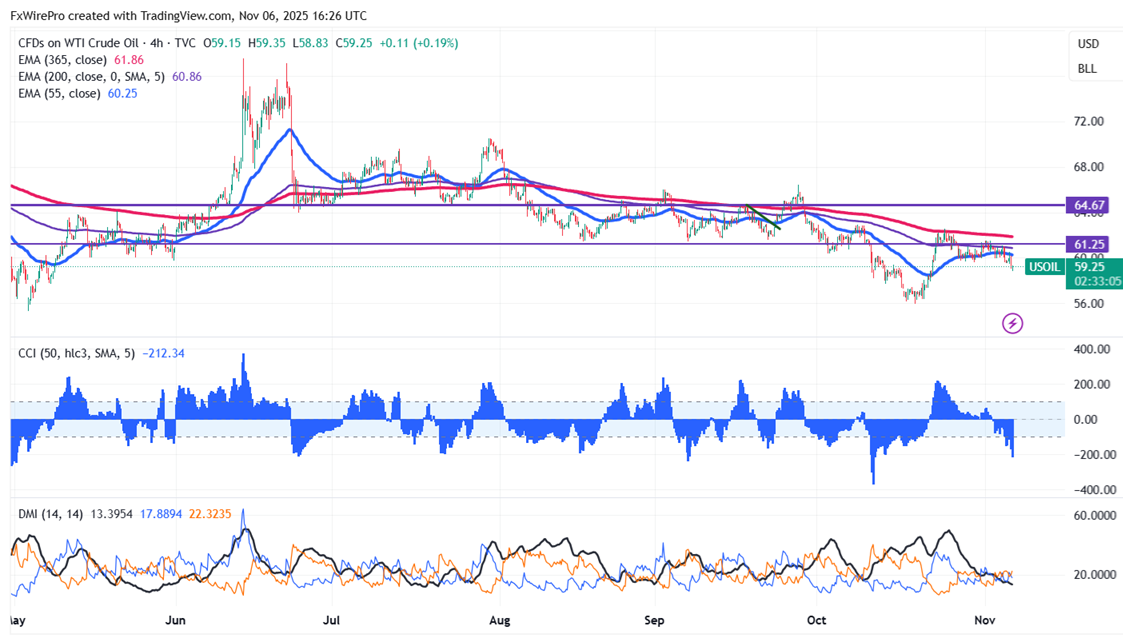
Crude oil prices pared most of their gains on weak demand. It hit an intraday low of $58.83 and is currently trading around $59.28.
Oil prices are under heavy downward pressure from a confluence of bearish factors: U.S. crude inventories surged by 5.2–6.5 million barrels last week, far exceeding forecasts, while global demand growth limps at just 850,000 bpd year-to-date, below expectations. Fresh U.S. sanctions on Rosneft and Lukoil have slashed Russian seaborne exports and stranded over 380 million barrels at sea as China, India, and Turkey halt purchases, yet this supply disruption is overshadowed by looming oversupply—OPEC+ mulling higher output, Saudi Arabia cutting December prices to Asia to an 11-month low, Libya targeting 1.6 million bpd next year, and relentless non-OPEC production growth. A strengthening U.S. dollar further erodes buying power, leaving the market in a fragile stalemate where ample supply and sluggish demand consistently trump geopolitical shocks.
Price Resistance and Support Levels
The near-term resistance is around $61.80 (365 -4H EMA); any breach above this level could push prices higher to $62.40/$63/$63.84/$64.20/$65/$66.40.On the downside, immediate support is at $58.80 violation below targets $57.97/$55.
It is good to sell on rallies around $61.48-50 with a stop-loss around $62.40 and a target price of $55.