Internet connected devices need power. That either means connecting them to the grid, which limits what we can use them for, or using batteries. So as the Internet of Things grows and more and more internet-enabled devices and sensors are rolled out as is expected, it could produce billions of extra batteries that have to be recycled every year, or else will just be thrown away.
The average UK household already uses an estimated average of 21 batteries a year. In total, this leads to an annual figure of 20,000-30,000 tons of general purpose battery waste. Only a very small number of these batteries are recycled (less than 2% of disposable batteries and around 5% of rechargeable ones) and most waste batteries end up in landfill sites.
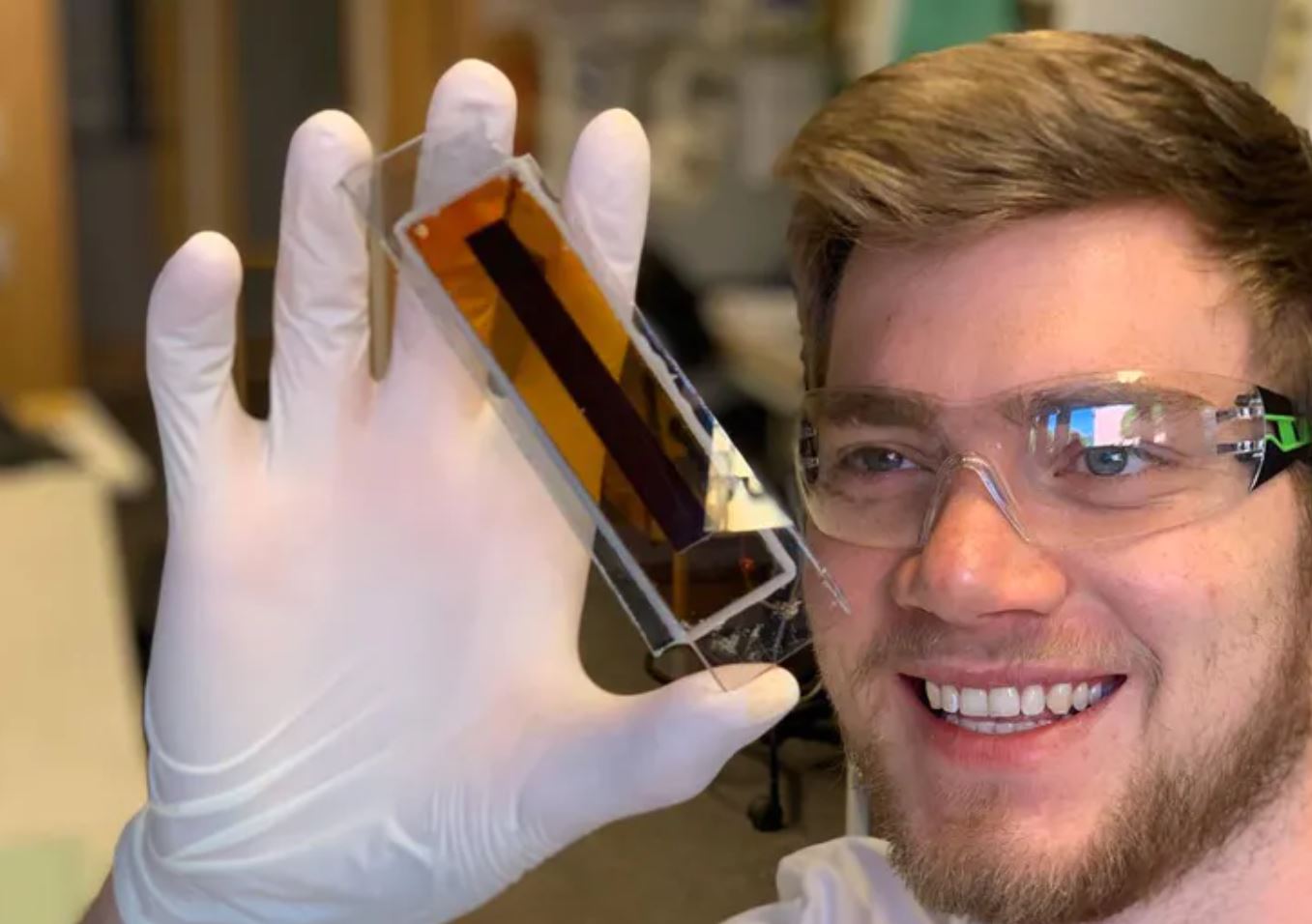
To avoid this but still make the Internet of Things possible, my colleagues and I are helping develop a new type of smart solar cell that can adapt to the amount of available light, meaning it can work indoors. These cells can even outperform extremely efficient versions that are normally used for trips into space. They’re also based on a surprising discovery, that some solar cells can work better when the liquid electrolyte built into them dries out. For this reason, we call them “zombie solar cells”.
The cells are a type of “dye-sensitised” solar cell made from a thin film of material that works on different principle to the common silicon cells that make up solar panels we’re more familiar with. They usually comprise a dye that absorbs lights, freeing electrons to create a current that is then carried to the cell’s electrodes by a liquid electrolyte solution.
When the electrolyte dries out, the cell normally stops functioning. But this is not what happened when scientific curiosity led researchers to measure dried-out “zombie” solar cells made with a new electrolyte based on copper complexes. They discovered the cells actually worked better than when they were liquid-filled.
We are currently still investigating why the solid copper complexes work better. But as well as providing a better rate of electron transfer, these new cells use more readily available materials and are easy to synthesise. The latest generation of zombie solar cells can even run on artificial ambient light instead of sunlight because, like plants, they are optimised to absorb the most energy-rich parts of the light they are exposed to.
These indoor solar cells have power conversion efficiencies of 30%-34%, even when scaling their size to the size of credit cards or mobile phones. In fact, the cells are so efficient that they harvest the equivalent of a small battery every few days.
Smart zombies
In collaboration with the team led by Prof Alessio Gagliardi from the Technical University of Munich, my research group has now used these new light harvesters to create “smart zombies”. These are wireless devices that harvest indoor light at extremely high efficiencies. They are intelligent enough to adapt to the amount of light available while performing the essential tasks of an Internet of Things device (communication, processing and sensing).
Using machine learning algorithms to work out the best pattern of usage, the smart cells intermittently enter a sleep mode to save harvested energy into a small energy buffer. They tend to sleep longer when there is less light available, and execute more of their essential tasks when there is more light available.
Being able to use an ambient light power source so efficiently in this way means that we can develop a new class of Internet of Things devices that just wouldn’t have been practical before. This opens the possibility of devices that can assist in many more areas, from smart packages that send themselves back if they’re dropped, to environmental sensors that can could detect when everyone has left a room and lower the temperature.
This could also enable some devices to become truly smart as opposed to simply remote controlled. One example here is the thousands of electronic price tags that can be found in supermarkets. They are currently battery-powered and updated as rarely as possible to extend battery life. With indoor photovoltaic panels, they could be developed to automatically change their price when the food is about to expire or overstocks need to be sold.
Without the need for batteries or a grid connection, you could have dozens of small devices and environmental sensors around the home, and hundreds or even thousands around large workplaces such as supermarkets or warehouses.
Our smart zombie cells are currently a lab-scale prototype. But other companies have already started to produce indoor solar cells. So, in principle, making our adaptive low-light cells a commercial reality could be done very quickly.