
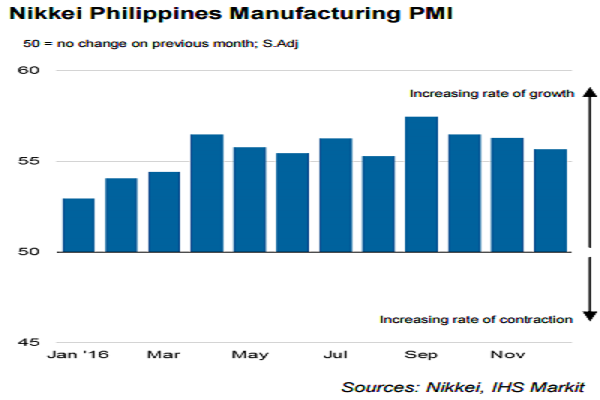
The growth of manufacturing in Philippines eased during the month of December, following a slower rise in new orders and as vendor performance deteriorated for the first time in survey history. Also, input cost inflation reached to survey high, accompanied by output price hikes.
At 55.7 in December, compared to 56.3 in November, the headline Nikkei Philippines Manufacturing Purchasing Managers Index (PMI) signalled another solid expansion in the Filipino manufacturing industry.
However, the headline index slowed for a third time in a row, where the latest reading was barely above the series average. While the increase in production volumes accelerated in the month, the rate of growth in total new sales decelerated for the third straight month.
Higher output was led by greater new orders placed at Philippines manufacturing firms, which reflected strong client appetite. However, the rate of expansion in new work was the slowest since March. Client demand from foreign markets continued to strengthen at the end of the year but at a slower pace after expanding at a record high rate in November.
Meanwhile, average lead times lengthened for the first time in the series history during December, though the rate of deterioration was moderate overall. Firms cited port congestions and custom bottlenecks as factors. Input cost inflation accelerated to the sharpest on record but the rate of increase in charged prices was broadly stable.
"On the prices front, Philippines manufacturing companies faced the sharpest rise in cost inflation in December as a combination of peso weakness and higher costs for raw materials lifted input prices. At the same time, hikes in selling prices were at broadly similar pace to recent months. If this continues, manufacturers’ profit margins may come under pressure in the coming months," said Bernard Aw, Economist, IHS, Markit.

