The Japanese defense ministry said its military hospital in Tokyo will be treating two injured Ukrainian soldiers. This marks Japan’s latest measure to support Ukraine as the war continues for nearly 15 months.
The Japanese defense ministry said on Thursday that two injured Ukrainian soldiers will be treated at Japan’s Self-Defense Force Central Hospital in Tokyo. The hospital is expected to admit the two soldiers next month for rehabilitation treatment, but did not reveal the details of the soldiers’ injuries or if the hospital plans to receive more injured soldiers from Ukraine in the future. A senior member of the country’s governing coalition told Reuters that this would be the first time the hospital will treat foreign soldiers.
The lawmaker said that the costs would likely be shouldered by Japan. The measure also comes as leaders of the G7 countries are having their summit in Hiroshima starting on May 19 to May 21. Support for Ukraine and sanctions on Russia would likely be on the agenda for the three-day conference.
On Friday, the British defense ministry said there was a train derailment near Simferopol on Thursday, blocking the only rail line to Sevastopol, where the Russian Black Sea fleet is based. Authorities in the area have apparently blamed the incident on outsiders, according to the ministry in its intelligence bulletin.
“Russia will move to repair the line quickly, but the incident will disrupt deliveries of supplies and potentially also weaponry, such as Kalibr cruise missiles” to the Black Sea Fleet, the ministry said.
“Any sabotage in this sensitive area will further increase the Kremlin’s concerns about its ability to protect other key infrastructure in Crimea. The peninsula retains a vital psychological and logistical role in enabling Russia’s war in Ukraine,” said the ministry.
The United Kingdom also announced a new round of sanctions on Russia on the same day, targeting firms connected to the theft of Ukrainian grain and those who are involved in the shipment of Russian energy.
The UK said in a statement that it was sanctioning 86 individuals and entities as part of a new crackdown on what London refers to as “shady individuals and entities” linked to the theft and resale of Ukrainian grain.
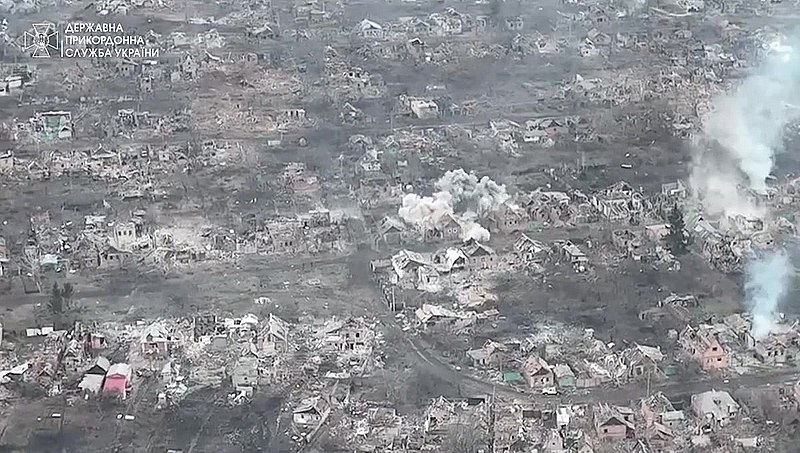
Photo: dpsu.gov.ua/Wikimedia Commons(CC by 2.0)