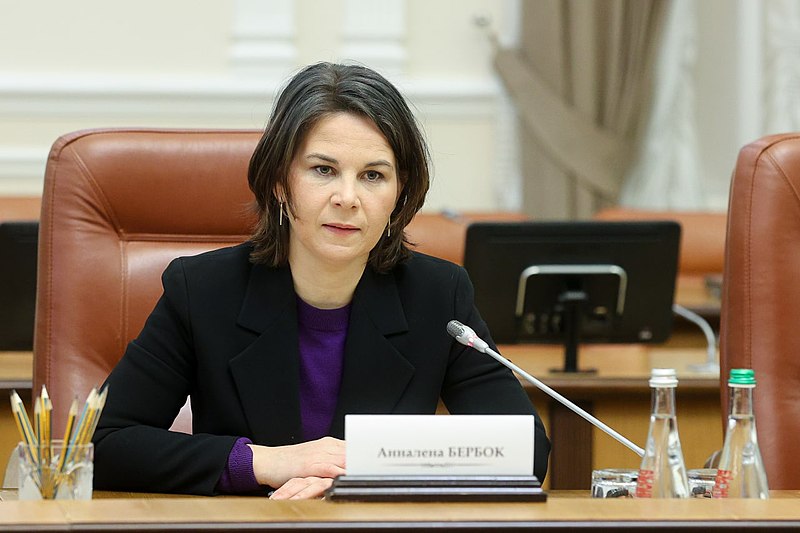
German foreign minister Annalena Baerbock said Berlin is ready to authorize transfers of Leopard tanks by Poland to Ukraine. The comments come as Berlin is under pressure from Kyiv and allies to deliver the tanks that would be used in the war effort.
Speaking after the Franco-German Summit on Sunday in Paris, Baerbock was pressed on whether Germany would authorize Poland and other countries who seek to transfer some of its Leopard tanks to Ukraine. Baerbock said that Berlin is ready to authorize Poland’s transfer should Warsaw make a request.
“If we are asked the question, then we will not stand in the way,” Baerbock told LCI Television. “We know how important these tanks are and this is why we are discussing this now with our partners. We need to make sure people’s lives are saved and Ukraine’s territory liberated.”
Baerbock’s comments appear to suggest that Berlin was ready to authorize other countries who are looking to transfer their German-made Leopard tanks to Ukraine. Under the licensing agreement, countries cannot send German-made tanks without Berlin’s approval.
Poland announced that it was ready to send Ukraine 14 of its Leopard tanks, deemed the most suitable in the ongoing war. However, Polish Prime Minister Mateusz Morawiecki said on Sunday that he was waiting for Germany to make a “clear statement” on whether countries that have Leopard tanks can transfer them to Ukraine.
Morawiecki also criticized Germany’s refusal so far to send its own tanks to Ukraine.
On Saturday, the foreign ministers of the three Baltic countries, Latvia, Estonia, and Lithuania, all urged Germany to provide Ukraine with Leopard tanks as soon as possible.
On Monday, in a downgrading of relations, Estonia and Russia expelled each other’s ambassadors, saying that their respective diplomatic missions would be led by the charge d’affaires in a tit-for-tat move in light of Moscow’s invasion of Ukraine.
The move has since prompted Latvia to announce that it will downgrade relations with Russia by February 24, the date that will mark the one-year anniversary since Russia started the war.
The Russian foreign ministry said it was expelling the Estonian ambassador, accusing Estonia of “Russophobia” and that its leaders “destroyed the entire range of relations with Russia.”
Estonian foreign minister Urmas Reinsalu said the departure of the Russian ambassador in Estonia would take place at the same time as the departure of the Estonian ambassador in Russia in accordance with the “principle of parity.”