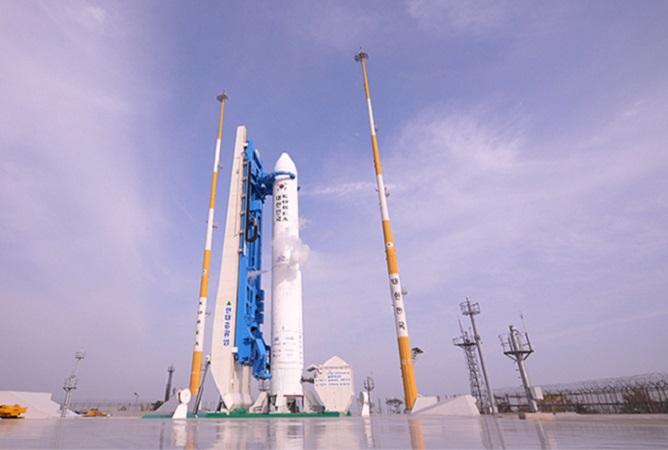
South Korea will invest 12 billion won in developing high-performance, liquid-fuel engines by next year as part of its space project, according to the ICT and science ministry.
The country unveiled the "Space Challenge" program in 2020 intending to invest 49.6 billion won until 2028 to secure future space industry technologies and leadership in 2030.
Of the total, the ministry has set aside a budget of 4.5 billion won this year and 7.5 billion won for 2023 to develop a 100-ton liquid-fuel engine.
The project also seeks to develop the next-generation rocket to succeed the Nuri rocket, which was equipped with 75-ton engines.
Nuri, also known as the KSLV-II, is South Korea's first homegrown space launch vehicle that successfully flew to a target altitude of 700 kilometers in October last year.
However, Nun failed to put a dummy satellite into orbit as its third-stage engine burned out sooner than expected.
South Korea plans to launch its first lunar orbiter this year.


Tabletop particle accelerator could transform medicine and materials science
U.S. Stock Futures Slip After CPI-Fueled Rally as Markets Weigh Economic Uncertainty
Canada Signals Delay in US Tariff Deal as Talks Shift to USMCA Review
RBA Unlikely to Cut Interest Rates in 2026 as Inflation Pressures Persist, Says Westpac
FDA Adds Fatal Risk Warning to J&J and Legend Biotech’s Carvykti Cancer Therapy
Neuralink Expands Brain Implant Trials with 12 Global Patients
New Zealand Business Confidence Hits 30-Year High as Economic Outlook Improves
CDC Vaccine Review Sparks Controversy Over Thimerosal Study Citation
Asian Fund Managers Turn More Optimistic on Growth but Curb Equity Return Expectations: BofA Survey
NASA and Roscosmos Chiefs Meet in Florida to Discuss Moon and ISS Cooperation
BOJ Poised for Historic Rate Hike as Japan Signals Shift Toward Monetary Normalization
Trump Signs Executive Order to Boost AI Research in Childhood Cancer
BoE Set to Cut Rates as UK Inflation Slows, but Further Easing Likely Limited
Lab-grown meat: you may find it icky, but it could drive forward medical research
South Korea Warns Weak Won Could Push Inflation Higher in 2025 


