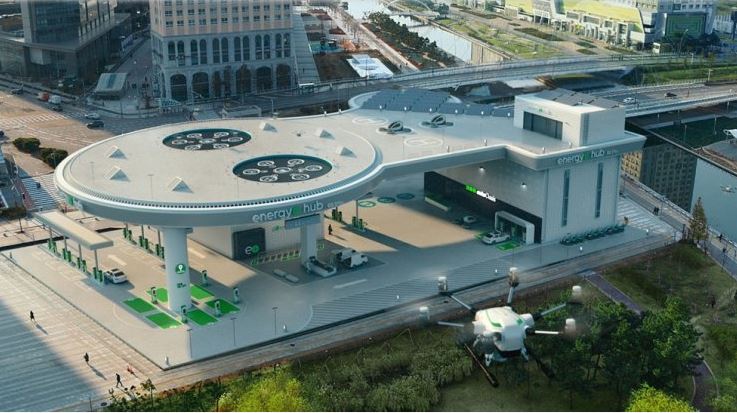
The Seoul Metropolitan Government will experiment with transforming gas stations into logistics hubs of the future.
Construction will begin in December and is expected to be completed by early next year.
There is a higher demand for distribution due to the growing popularity of online transactions and the diversification of logistics channels.
However, the city’s warehouses and logistics complexes only account for 6 percent of those in Gyeonggi Province.
Seoul responded by collaborating with GS Caltex Corp. to turn a gas station in Seocho District into an experimental platform for a future logistics hub.
The gas station will have a Smart Micro-fulfillment Center (MFC), a 120 square-meter unmanned, automated storage facility.
Around 3,600 shipments will be sent out each day by the Smart MFC, which will be operated by five to six robots. Drones will deliver the packages.
To test out short-range drone deliveries, the city will erect a drone station on the gas station's rooftop.


Deutsche Bank Fined A$2 Million by ASIC Over OTC Derivatives Reporting Errors
Britain has almost 1 million young people not in work or education – here’s what evidence shows can change that
Asia Stocks Slip as Iran-Hormuz Tensions Lift Oil Prices, Dollar and Bond Yields
Elon Musk Says Anthropic Leads AI Race as Claude Models Challenge OpenAI
Dollar Slips as Oil Prices Ease, Fed Rate Outlook Remains Uncertain
AI is driving down the price of knowledge – universities have to rethink what they offer
Every generation thinks they had it the toughest, but for Gen Z, they’re probably right
Zhipu AI Raises HK$31.37 Billion in Discounted Share Sale to Accelerate AI Growth
How is Antarctica melting, exactly? Crucial details are beginning to come into focus
Dollar Rises as Middle East Conflict Fuels Inflation and Rate Hike Fears
Why have so few atrocities ever been recognised as genocide?
Morgan Stanley Names Marks & Spencer Top European Retail Pick, Sees Strong Upside
Muji Owner Ryohin Keikaku Stock Soars After Raising Full-Year Earnings Forecast
Lake beds are rich environmental records — studying them reveals much about a place’s history
The UK is surprisingly short of water – but more reservoirs aren’t the answer 


