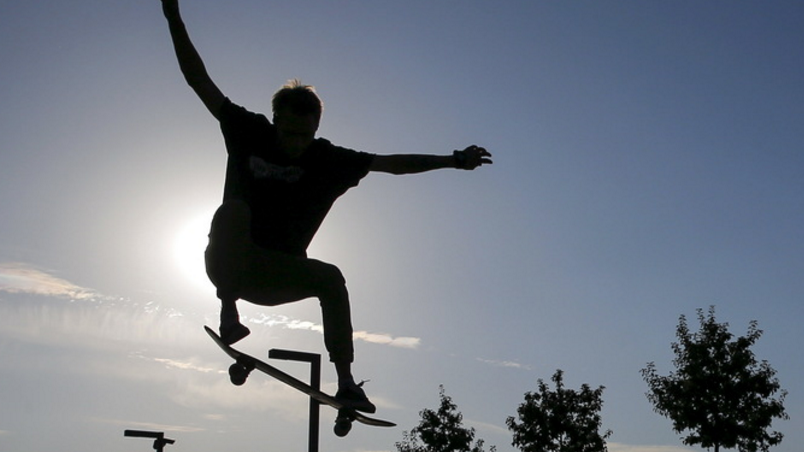
The City of Melbourne is spending hundreds of thousands of dollars to resurface Lincoln Square, a popular square in inner-city Carlton, to make it unsuitable for skateboarders.
The square is widely regarded as one of Australia’s best skateboarding spots. According to a council spokeswoman, a law making skateboarding illegal in the square was passed in 2009, but it was hard to enforce because of the site’s popularity.
“Complaints are regularly received about noise, skating at unreasonable hours of the night, anti-social behaviour, pedestrian safety, and skating on the Bali bombing memorial,” she told Fairfax Media.
The memorial to the Bali bombings is at the centre of the square. It consists of 91 jets of water in a fountain representing each Australian who lost their life. (All 202 bombing victims are represented by 202 lights in the memorial.)
This memorial clearly deserves respect – as does public property. But might a compromise solution to these competing tensions have been found? Elsewhere, in disputes over shared public space, young people have sometimes come up with innovative solutions, particularly when it concerns places they are passionate about.
From my perspective, as a public health expert who has studied skateboarding, this case is replete with ironies. My interest in this topic grew out of earlier research into urban environments and wellbeing in which adolescents lamented their exclusion from many places in the public realm.

The Bali Memorial Fountain at Lincoln Square. Chris Samuel/Flickr
Irony one
Concerns about anti-social behaviour are often cited by those opposing skateboarding in public places, but empirical evidence is sparse. In fact, a greater weight of evidence suggests that it is the lack of things for young people to do that is more likely to fuel undesirable activity.
Of course there are sometimes complaints as seen in the case of Lincoln Square, but in my decade of researching and speaking with local governments about skateboarding, this is typically a vocal minority, and “shutting it down” doesn’t have to be the answer.
Rarely mentioned in these kinds of debates, is the capacity of skateboarding to generate positive social behaviours.
In a community survey (387 people, including non-skaters) we undertook for an inner metropolitan local council in Western Australia, pro-social behaviours (such as socialising with friends, respecting others and cooperation) were far more likely to be reported.
Anti-social behaviours (including drinking, drug use, graffiti, vandalism and collisions) were typically reported as rarely or never occurring.
These are more than just social niceties. Developmentally, important life skills are informally fostered when a bunch of young people learn to take turns, share a confined space, face new challenges publicly, and pick themselves (or others up) after a fall.
Irony two
“Activitating” public places has become a buzzword in urban planning policies and local government initiatives. Having people out and about not only adds to a community’s social vibrancy but also contributes to safety by having more “eyes on the street”.
Conversely, deserted streets and public places erode perceptions of safety and are more likely to engender undesirable activity. Skateboarding can thus help “activate” public places – in a low cost and uncontrived way.

Fernando de Sousa, CC BY-SA
In sharp contrast to events in Melbourne, the mayor of the West Australian city of Fremantle Brad Pettit has championed the recent building of a skate and youth plaza. He argued it was the lack of people around in public places that could foster anti-social behaviour and make people feel unsafe.
And while it might not to be to everyone’s taste, skateboarding can contribute to a place’s ambience. This is something that some local councils have sought to create – for example with the skateable surfaces at the Geelong waterfront – or preserve, as seen with the Southbank undercroft popularised by skaters in London.
Irony three
The prevailing stereotype of skateboarding as the pastime of a minority of teenage males is enormously out of step with reality.
The ABS reports that youth participation in activities such as skateboarding and scootering now outnumbers participation in more traditional sport, with up to 21 per cent of Australian young people estimated to engage in skating.
Similarly, a report to the Australian Sports Commission noted the rising popularity of skateboarding and a shift towards less formally organised recreational activity.
Its popularity among younger children and girls is also evident, with a study of Western Australia students in primary years 5–7 finding that 33.8 per cent of boys and 18.3 per cent of girls had skated in the previous week.
Irony four
Growing concerns about the alarming rates of obesity, physical inactivity and screen use among young people, would suggest that skateboarding should be encouraged – not sanctioned.
Indeed, it ticks many boxes as the ideal recreational activity. There is no fee, uniform or coach required, and it can be paced to your own ability or level of coordination. For many young people it also doubles as a cheap and easy mode of transport.
Of course skateboarding is not immune from injury risk. But increasing evidence – and our own research around children’s play – suggests that risk aversion and the phenomenon of “cotton wool kids” have greater adverse impacts on child development and resilience.
The final irony
The final irony lies in the mixed messages society signals to young people when it discourages or “designs out” their recreational pastimes, as will occur with the Lincoln Square makeover.
For younger children, playgrounds are visual signals of their inclusion in community, but teens often feel they are viewed warily in the public realm.
Adults might associate young people “hanging out” with loitering or time wasting, but for adolescents particularly, it’s a vital part of their social development.
The council spokeswoman has reportedly said “more appropriate spots would be sought for skateboarders in the city”. But Lincoln Square is a place that young people have already identified as important to them.
Dedicated skate facilities have their role but young people want to feel included across the city. Young skaters are citizens too.
 Lisa Wood does not work for, consult, own shares in or receive funding from any company or organization that would benefit from this article, and has disclosed no relevant affiliations beyond the academic appointment above.
Lisa Wood, Associate Professor Population Health
This article was originally published on The Conversation. Read the original article.