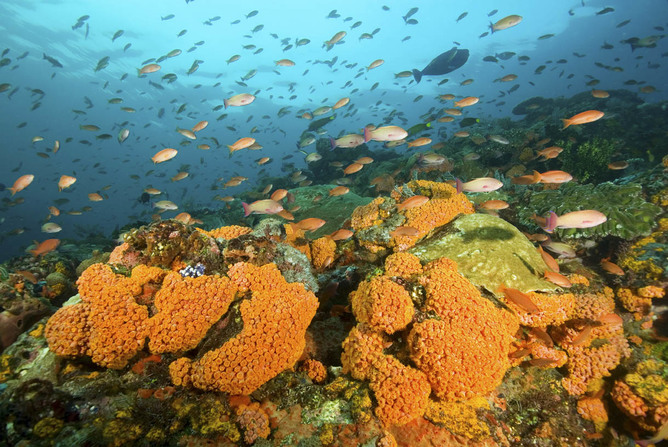
It was Charles Darwin, almost 200 years ago, who first asked how it could be that coral reefs could flourish in relatively barren parts of the Pacific Ocean. This conundrum subsequently became known as Darwin’s Paradox.
A study published this week in Nature Communications helps answer just how coral oases can exist in oceanic deserts.
The simple explanation is the presence of microscopic aquatic plants known as phytoplankton. The more complicated, scientific answer – that asks why coral islands are such productive hotspots – is known as the Island Mass Effect (IME).
The findings of the new study provide scientists who study marine fisheries and habitats with important insights into how coral reef island systems can be so productive, acting as hotspots of species diversity which, in turn, help populate fisheries and provide coastal protection. This knowledge can help inform ocean management plans, particularly as ecosystems respond to climate change.

Illustration of the Island Mass Effect from the new study published in Nature.
The Island Mass Effect (IME)
The IME, first described by the University of Hawaii botanist Maxwell S. Doty and colleagues, is a phenomenon in which the growth of phytoplankton is enhanced close to island-reef ecosystems.
Until now, all studies trying to explain the reasons for the IME have been done over small, geographically confined areas, such as a single island or coral reef group.
This is where the Nature Communications paper’s lead author, Jamison Gove of the National Oceanic and Atmospheric Administration (NOAA), and his colleagues come in.
Their new study is the first to describe the IME over the scale of an entire ocean and discusses the role of both natural and human island populations on phytoplankton growth.
The team measured just how much phytoplankton grew around small islands and atolls in two ways. They used satellite imagery over a decade and direct ship-based surveys to verify that their image estimates were correct.
The IME was found to be near-ubiquitous, with 91 percent of the coral ecosystems studied demonstrating the phenomenon, some showing as much as 86 percent more phytoplankton biomass compared to neighboring ocean areas.
In other words, phytoplankton coral island hotspots surrounded by barren oceans landscapes were nearly everywhere the team looked.
The higher rate of phytoplankton growth around the coral islands is caused by nutrients that result from decomposing reef animals, upwellings of nutrient-rich colder waters toward the surface, the mixing effects of waves and currents, and sedimentation from land erosion. There are also human-derived runoffs from agriculture, urban development and wastewater inputs, which all add nutrients to coastal waters.

Lead author Jamison Gove (NOAA) retrieving oceanographic equipment with a colleague. Chip Young (NOAA)
Who cares about the IME or Darwin’s Paradox?
Microscopic phytoplankton play an outsize role in ocean life.
By converting the sun’s energy into plant growth, they are an essential component in our oceans and drive the structure of food webs and ultimately global fisheries yields. More phytoplankton also means more energy-rich resources for important reef building organisms that determine the architecture of tropical coral reefs, which provide protection for neighboring coastlines.

Southern Line Islands. High productivity means more coral growth and cover offering coastal protection to island nations and increased biodiversity and abundance. Brian Zgliczynski - Scripps Institution of Oceanography, San Diego, California
Increased levels of phytoplankton are, however, not always good news. Extreme levels of nutrient enrichment from runoff related to agriculture and other human activities have been shown to increase phytoplankton biomass to levels that can cause sea population structures to change entirely. High levels of nutrients have also led to mass mortalities of more sensitive, yet important species along with the suppression of reef growth.
By better understanding the role of the IME and its impacts on fisheries as well as the negative effects of high human-derived nutrient enrichment, island nations can focus marine conservation efforts on ensuring they do not overload local reef systems past such tipping points.
The future of coral islands
Climate change is predicted to raise ocean temperatures, which will lower lower ocean productivity by changing the way our oceans cycle and mix around the planet. The IME will therefore be an ever important phenomenon to understand as we develop plans to support coral reef ecosystems in the future to avoid stresses from warmer waters.
To sustainably exploit tropical fisheries and continue to rely on coral reefs to protect nearshore human populations, research should focus on understanding the processes that make coral islands and atolls hotspots of productivity. We must dive deeper into questions Darwin was asking some 180 years ago while applying them to today’s global oceans and predicted future change.

Booming productivity at Palmyra Atoll, central Pacific the Island Mass Effect bringing huge fisheries rewards to an otherwise empty ocean. Gareth J Williams, School of Ocean Sciences, Bangor University, UK
 Andrew Frederick Johnson receives funding from International Community Foundation, National Science Foundation, Helmsley Charitable Trust.
Andrew Frederick Johnson, Postdoctoral Researcher of Marine Biology at Scripps Insitution of Oceanography, University of California, San Diego
This article was originally published on The Conversation. Read the original article.