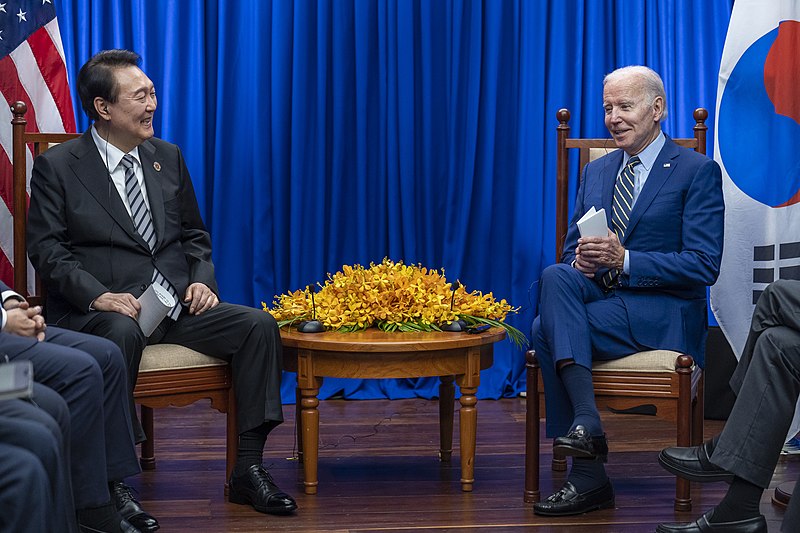
South Korean President Yoon Suk-yeol is traveling to the United States in what would be the first state visit by a South Korean leader in 12 years. Yoon will be meeting with US President Joe Biden at a time of concern in South Korea regarding the extended deterrence the US has with the nation.
Yoon will be in the US from April 24 to 29, and aside from the visit being the first time in 12 years, it also marks the 70th anniversary of the partnership between Washington and Seoul. Yoon’s visit also comes as questions have emerged in South Korea on its reliance on the US extended deterrence or nuclear umbrella, as North Korea has sought to ramp up its nuclear and missile programs. Some of the questions have even come from Yoon’s own party, with calls for Seoul to develop its own nuclear weapons.
Yoon has sought to push for South Korea to have a say in operating the US extended deterrence, but it remains to be seen what that would mean. Yoon’s deputy national security adviser Kim Tae-hyo told reporters that both sides are working on measures to operate the extended deterrence in a more concrete manner, and it would hopefully be addressed in a joint statement following the meeting.
“What I can tell you now is people’s interest and expectations for extended deterrence have been great and there are several things that have been carried out over the past year in terms of information sharing, planning, and execution,” said Kim.
“We need to take steps to organize these things so that it can be easily understood to anyone in one big picture, how this is implemented and developed.”
Meanwhile, Seoul has restored Japan to its list of countries that it gives preferential treatment in trade three years after the two allies downgraded each other’s trade status over a long-running historical dispute.
The South Korean trade, industry, and energy ministry announced the move on Monday through a government gazette. The ministry also said it would be further restricting technology and industrial exports to Russia and Belarus in support of the US-led sanctions against Moscow over its invasion of Ukraine.